
You’re carefully tending your indoor garden, but your plants are getting leggy. The stems stretch, the spaces between leaves widen, and you’re left with weak, floppy growth instead of the bushy, robust plants you envisioned. This isn’t just an aesthetic issue; it’s a structural one that impacts yield, health, and light efficiency. The culprit and the solution often lie directly overhead, in your lighting strategy.
Modern smart grow lights give you unprecedented control over your plants’ architecture. By manipulating light spectrum, intensity, and duration, you can directly influence internode elongationthe distance between leaf nodes on a stem. This is the science of Photomorphogenesis: how light signals, not just energy, dictate plant form and structure. For a reliable, full-spectrum starting point that offers excellent value, many indoor gardeners begin with the GooingTop LED Grow light. It provides a solid foundation of Photosynthetically Active Radiation (PAR) to understand your plants’ basic needs before diving into more advanced spectral tuning.
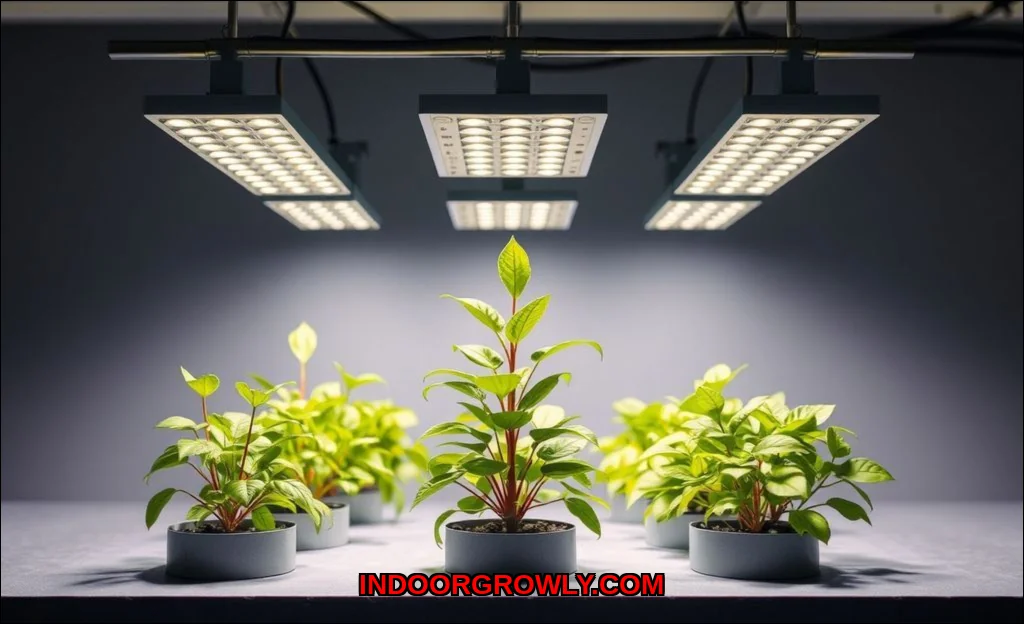
What is Internode Spacing and Why It Matters
Internode spacing is the length of stem between two successive nodes, the points where leaves, branches, or flowers emerge. Think of it as the plant’s architectural blueprint. Tight, compact spacing indicates sturdy, efficient growth. Excessive spacing, or stem stretching, signals a plant scrambling for resources.
Why should you care? Compact plants are stronger plants. They support heavier fruit, resist pests better, and create a more uniform canopy that maximizes light capture for every leaf. In contrast, elongated stems are prone to breakage, waste energy on structural support instead of production, and can create a sparse, inefficient garden. Managing this is a core part of effective canopy management.
The Science: How Light Signals Control Stem Growth
Plants don’t just see light; they interpret it. Specialized photoreceptors act as molecular eyes, detecting specific wavelengths and triggering hormonal responses that shape growth.
Key Photoreceptors and Their Roles
- Phytochrome: This is the master regulator for internode elongation and the shade avoidance response. It exists in two interconvertible forms (Pr and Pfr) sensitive to red (R) and far-red (FR) light. The Red:Far-Red Ratio (R:FR) is the critical signal. A high R:FR ratio (lots of red, little far-red) tells the plant it’s in full sun, promoting compact growth. A low R:FR ratio mimics shade from competitors, triggering Shade Avoidance Syndrome (SAS) and rapid stem stretching.
- Cryptochrome: Activated primarily by blue light, these photoreceptors work to suppress stem elongation. The blue light effect on plants is one of inhibition, promoting tighter nodes and thicker stems.
- Phototropin: Guides directional growth toward light sources but also plays a role in general growth inhibition under high blue light.
The expert insight here is profound: It’s not merely the presence of blue light, but the balance between wavelengths. A higher blue-to-red ratio activates cryptochrome and suppresses gibberellin (a stretching hormone), directly combating stem stretching. This intricate dance of signals is what you’re managing with a smart light. For a deeper dive into how these signals affect other plant parts, explore our guide on how smart grow lights influence leaf development.
Key Light Parameters for Controlling Internode Length
To design your light recipe for compact growth, you need to master these four parameters. Smart lights let you adjust them dynamically.
1. Light Spectrum: The Color Recipe
This is your most powerful tool for manipulating plant architecture.
- Blue Light (400-500nm): The compact growth promoter. It’s essential for dense, sturdy seedlings and vegetative growth. Asking “does blue light make plants shorter?” The answer is yes, by activating cryptochrome photoreceptors.
- Red Light (600-700nm): Drives photosynthesis but, in excess without blue, can promote elongation. Its interaction with far-red is key.
- Far-Red Light (700-800nm): In small doses, it can benefit plant development, but too much drastically lowers the R:FR ratio, inducing shade avoidance and stretch.
Smart light control & automation excels here. You’re not stuck with a static spectrum. You can program a “bushy veg” recipe with elevated blue and a high R:FR ratio, then shift to a flowering recipe. This is more advanced than simple on/off switches.
2. Light Intensity: Measured by PPFD
Photosynthetic Photon Flux Density (PPFD) measures how many photosynthetically usable photons hit a specific area per second. It’s intensity. Low light intensity is a classic cause of stretchthe plant grows taller to reach a better light source. You must provide sufficient PPFD for your plant’s stage to satisfy its energy needs without triggering light stress avoidance behaviors like excessive elongation.
3. Photoperiod and DLI: The Daily Dose
Daily Light Integral (DLI) is the total number of photosynthetic photons delivered over a 24-hour period. It’s PPFD multiplied by time. If your light intensity (PPFD) is low, you might try to compensate by running lights longer to hit the target DLI. This can work, but spectrum manipulation is often a more direct tool for controlling form. Getting DLI right is fundamental to overall indoor plant health with smart grow lights.
4. Light Uniformity: Avoiding the Stretch Zone
If your light has hot spots and dim corners, plants in the dim areas will stretch toward the brighter ones. A uniform canopy PPFD is crucial for uniform compact growth.
Practical Strategies Using Smart Grow Lights
Let’s translate science into action. Heres how to program your lights for optimal spacing.
For Seedlings and Clones: The Compact Foundation
This is the most critical phase for preventing stretch. Your goal is the best light spectrum for compact seedlings.
- Spectrum: Use a spectrum with 20-30% blue light. Many smart lights have a “seedling” or “clone” mode that emphasizes blue and cool white LEDs.
- Intensity: Start with a lower PPFD (100-200 mol/m/s) and increase gradually as they establish.
- Distance: Keep lights closer (12-24 inches) to provide intense, blue-rich light without overheating.
For Vegetative Growth: Building a Bushy Structure
You’re actively shaping the plant’s architecture here. This is where you apply smart grow light settings for bushy plants.
- Spectrum: Maintain a strong blue presence (20-25%) to suppress gibberellin. Program your smart light to maintain a high R:FR ratio. Avoid spectra heavy in deep red and far-red during this phase.
- Intensity: Increase PPFD to 400-600 mol/m/s for most leafy greens and herbs, higher for fruiting plants.
- Technique: Some growers use a “blue boost” for the first and last hour of the light cycle to further reinforce compact growth.
For Flowering and Fruiting: Strategic Stretch Management
Some stem elongation is natural and desired during the transition to flowering (the “flowering stretch”). You can manage it, not eliminate it.
- Spectrum: Gradually reduce the blue ratio and increase red to encourage flowering and fruit development. The key is a controlled shift. A sudden drop in blue and R:FR ratio can cause excessive, weak stretching.
- Expert Insight: Advanced growers use smart lights to dynamically manipulate the R:FR ratio day-by-day during this transition, controlling the stretch with precision.
Common Mistakes and Expert Tips for Optimal Spacing
Mistakes to Avoid
- Relying Solely on “More Light”: Cranking up intensity (PPFD) without regard for spectrum can cause light burn and stress, not necessarily compactness.
- Ignoring the R:FR Ratio: Focusing only on blue vs. red and forgetting the influence of far-red is a common oversight. Even a small amount of far-red can significantly impact elongation.
- Inconsistent Canopy Coverage: Creating dim zones guarantees stretch in those areas as plants reach for light.
- Keeping Lights Too Far Away: This reduces both intensity and the percentage of blue light reaching the plant (blue photons scatter more easily), doubling down on the stretch signal.
Pro Tips for Success
- Invest in a PAR Meter: Don’t guess your PPFD. Measure it. This is the single best tool to diagnose light-related stretch.
- Use Dimmable, Tunable Lights: The ability to adjust both spectrum and intensity is non-negotiable for precise canopy management. Brands like Philips, Spider Farmer, and Mars Hydro offer smart models with this capability.
- Monitor and Adapt: Observe your plants daily. The first sign of stretch is your cue to adjust your light recipeincrease blue, raise intensity slightly, or lower the lights.
- Combine Light with Environment: Remember, temperature and humidity also affect internode length. Higher temperatures often promote stretching. Integrate your light strategy with overall climate control.
For comprehensive reviews on equipment that can help you execute these strategies, trusted gardening publications like Bob Vila’s guide to the best grow lights and Epic Gardening’s grow light resource offer valuable, real-world testing insights.
Final Thoughts
Controlling internode spacing is a clear mark of a skilled indoor gardener. It moves you from passive plant keeping to active plant shaping. With smart grow lights, you’re no longer just providing energy. You’re having a conversation with your plants, using the language of light spectrum, intensity, and timing. You tell them when to stay compact and bushy, and when to stretch just enough to support a heavy harvest. Start by mastering the blue light and R:FR ratio for your seedlings. Observe, measure with a PAR meter, and let your plants’ architecture be the feedback that guides your next adjustment. The power to design growth is literally at your fingertips.