
Growing tomatoes indoors gives you complete control over their environment. The most critical factor you manage is light. Modern smart grow lights let you program the exact spectrum, intensity, and schedule your plants need. This guide walks you through programming them for maximum tomato yield and quality.
You’re not just turning a light on and off. You’re crafting a precise light recipe for tomatoes that changes as they grow. This involves managing Photosynthetic Photon Flux Density (PPFD), Photoperiod, and spectral quality. For a reliable, user-friendly option that handles these parameters well, many indoor gardeners start with the Necgemlex Smart LED. Its app-based control makes implementing the strategies below straightforward.
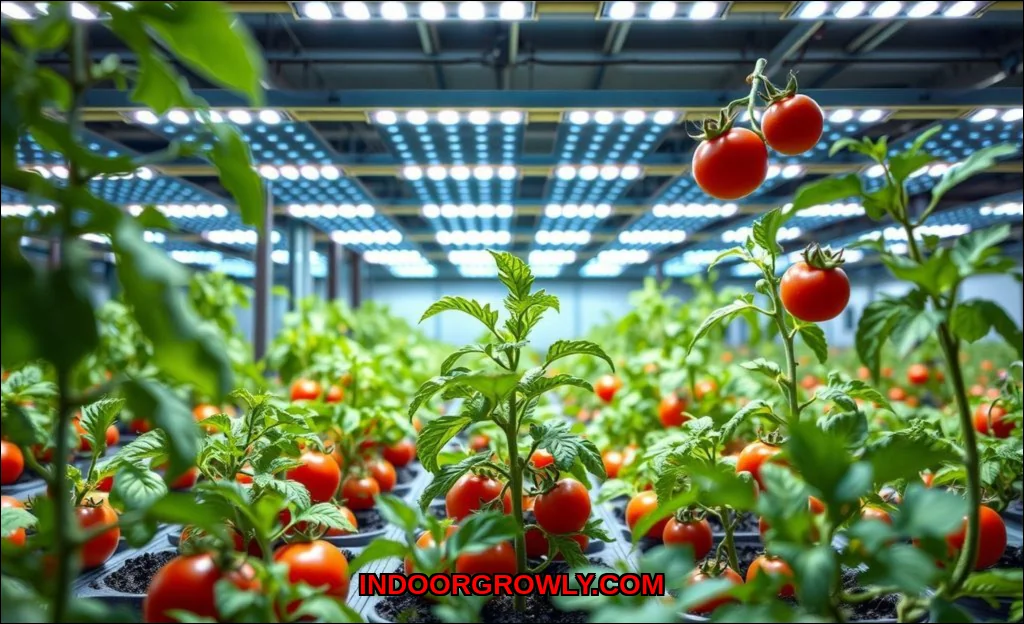
What Tomato Plants Need from Light
Tomatoes (Solanum lycopersicum) are high-light plants. In nature, they thrive under full sun. Replicating this indoors requires understanding a few key metrics of Photosynthetically Active Radiation (PAR).
Unlike some flowering plants, tomatoes are ‘day-neutral’ for triggering blooms. This means you focus light quality and quantity on health and fruit production, not flipping a flowering switch. Your two primary goals are to maximize photosynthesis without causing stress and to influence plant structure and fruiting with light color.
Key Light Metrics: PPFD and DLI
Think of PPFD as the instantaneous intensity of usable light hitting the leaf, measured in micromoles per square meter per second (mol/m/s). Daily Light Integral (DLI) is the total amount of PAR delivered over a full photoperiod, measured in moles per square meter per day (mol/m/day).
For robust tomato production, aim for a DLI of 20-30 mol/m/day. This is the expert target. You achieve this by balancing your PPFD setting with the length of your light cycle. A higher PPFD allows for a shorter day, while a lower PPFD requires a longer one.
Core Programming Parameters for Your Smart Lights
Your smart grow light setup will have three main levers to pull: spectrum, intensity (PPFD), and photoperiod. Programming them in harmony is the secret.
1. Programming the Light Spectrum
Spectral quality tells the plant how to grow. Full-spectrum white LEDs are excellent, but understanding the role of specific wavelengths lets you fine-tune.
- Blue Light (400-500nm): Promotes compact, sturdy vegetative growth. Essential for strong stems and preventing leggy seedlings.
- Red Light (600-700nm): The primary driver of photosynthesis. It encourages leaf expansion, flowering, and fruiting.
- Far-Red Light (700-800nm): Influences plant stretching and flowering responses. Increasing the red to far-red ratio during fruiting can improve yield and quality, a key expert insight.
Your LED spectrum for fruiting should be rich in reds. Many smart lights have “veg” and “bloom” modes. For tomatoes, use a balanced spectrum during vegetative growth, then increase the red proportion during flowering and fruiting stages.
2. Setting Intensity (PPFD) by Growth Stage
Light intensity needs must change. Heres a stage-by-stage guide for PPFD for tomatoes.
| Growth Stage | Target PPFD (mol/m/s) | Notes |
|---|---|---|
| Seedlings / Clones | 200 – 400 | Lower intensity prevents stress. This answers “what PPFD do tomato seedlings need“. |
| Vegetative Growth | 400 – 600 | Promotes healthy leaf and stem development. |
| Flowering & Fruiting | 600 – 900 | High intensity is crucial for fruit set, sugar development, and yield. |
Always adjust intensity gradually. A sudden jump can shock plants.
3. Managing Photoperiod and DLI
The Photoperiod is simply how long your lights are on each day. Since tomatoes aren’t photoperiod-sensitive for flowering, you set the duration based on your target DLI and your light’s maximum PPFD.
Formula: DLI = (PPFD Light Hours 3600) / 1,000,000
Example: If your light delivers 700 PPFD at the canopy and you want a DLI of 25, you’d need about 10 hours of light. (700 10 3600 / 1,000,000 = 25.2). A common, practical tomato light schedule is 14-18 hours on during veg and 12-16 hours on during fruiting, adjusted to hit your DLI target.
Step-by-Step Smart Light Programming Guide
Let’s translate theory into action. Heres how to set up smart LED lights for tomatoes from day one.
- Install and Position Your Light: Hang your light at the manufacturer’s recommended height for seedlings, usually 24-30 inches. Proper light positioning for hydroponic systems is just as critical for soil-based indoor tomatoes to ensure even coverage.
- Connect to the App/Controller: Pair your smart light (like a Necgemlex, Philips GreenPower, or HLG model) with its dedicated app or a smart controller/timer.
- Program Your First Schedule:
- Stage: Seedling
- Spectrum: Full spectrum or “Veg” mode.
- Intensity: Set to 25-30% power (or ~300 PPFD if adjustable).
- Photoperiod: Program a 16-hour on, 8-hour off cycle.
- Create Stage-Specific Programs: Most apps let you save programs. Create one for “Vegetative” and “Fruiting” with the appropriate spectrum and intensity settings outlined above.
- Set Transition Dates: Manually switch programs when your plants transition to the next stage, or if your system allows, schedule the change in advance.
Advanced Automation and System Integration
True automated grow lights go beyond a simple timer. They react to data.
Using DLC and Environmental Sensors
DLC control (Dimming, Lighting Control) allows your system to make micro-adjustments. You can integrate light sensors that measure canopy-level PPFD and automatically adjust dimming to maintain a set point, perfect for consistent DLI delivery even as plants grow.
Some advanced controllers can tie your light schedule to other devices. For instance, lights can dim if the room temperature gets too high, reducing heat stress.
Linking with Other Smart Devices
Use a smart home platform (like Google Home or SmartThings) to create routines. “Good morning” could ramp lights up to 60% power. You can also sync your lights with smart plugs controlling fans or irrigation for a cohesive environment. This level of control is similar to techniques used for other crops, like when you optimize smart lights for fast-growing microgreens, where precise timing is everything.
Troubleshooting and Optimization
Even the best light recipe for tomatoes needs tweaking. Watch your plants.
- Leggy Seedlings: Increase blue light spectrum and PPFD. Move the light closer.
- Leaf Scorch or Bleaching: Light intensity is too high. Increase height or dim the lights.
- Poor Fruit Set: Ensure PPFD during flowering is at least 600. Verify your red light spectrum is emphasized.
- High Energy Bills: Re-calculate your DLI. You may be able to reduce the photoperiod slightly if you can increase PPFD, or vice-versa, to find an efficient balance.
For deeper research on plant light responses, academic resources like this Frontiers in Plant Science article on light quality offer valuable insights. Practical guides from institutions like Penn State Extension are also excellent references.
Your Path to Perfect Tomatoes
Programming smart lights transforms you from a passive observer to an active director of your tomato crop’s growth. Start with the core principles: hit your DLI target with the right PPFD and photoperiod combo, shift the spectrum toward red as fruits develop, and use automation to ensure consistency. Monitor your plants closelythey’ll tell you if the PAR values are right. The first time you harvest a sun-sweet, indoor-grown tomato under your perfectly programmed lights, you’ll know the precision was worth it. Now, go craft that perfect digital sunrise.