
Starting seeds indoors gives you a head start on the gardening season. But weak, spindly seedlings can quickly dash those hopes. The right light makes all the difference, and modern smart grow lights offer precision control that was once only available to commercial growers. Your goal isn’t just to keep seedlings aliveit’s to cultivate stocky, vigorous plants ready for the great outdoors.
Choosing the best equipment can feel overwhelming with all the technical specs. You need a light that understands the unique needs of delicate seedlings. This guide cuts through the jargon. We’ll translate terms like PPFD and full spectrum LED into practical advice, so you can select a light that delivers robust growth from the first sprout. For gardeners seeking a powerful, feature-rich option right out of the gate, many professionals recommend the VIPARSPECTRA P700 Grow. Its dimmable intensity and robust spectrum are excellent for scaling from seedlings to mature plants.
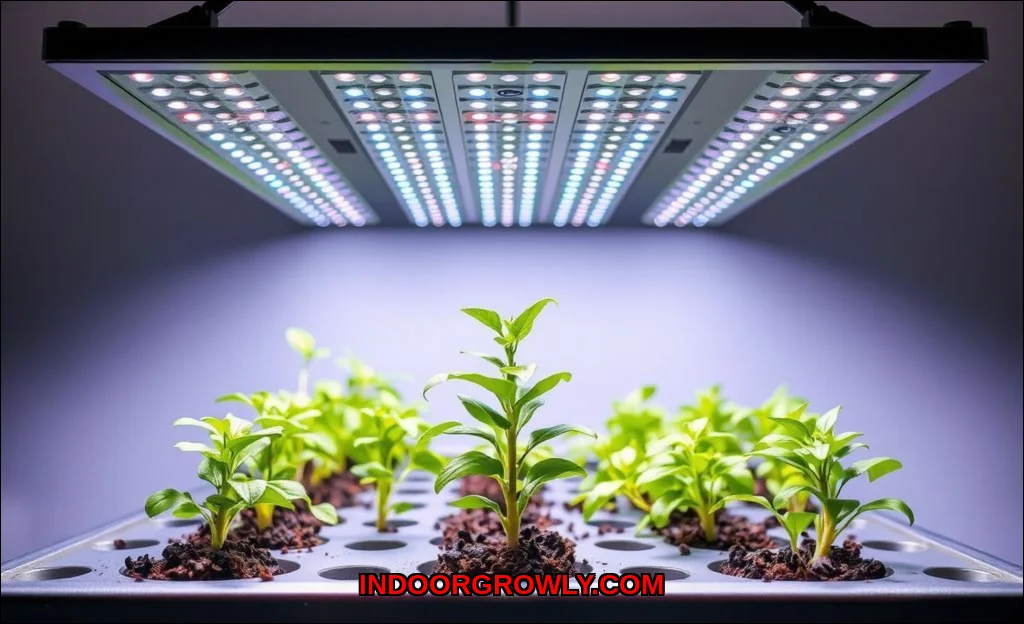
Understanding Seedling Light Needs: PPFD, Spectrum, and Photoperiod
Seedlings have specific, non-negotiable light requirements. Get these fundamentals wrong, and you’ll face stretched stems and slow growth regardless of your light’s “smart” features. Three concepts form the foundation: intensity, quality, and duration.
Light Intensity: Measuring with PPFD and DLI
Intensity isn’t about brightness to your eyes, but the number of usable photons hitting the leaves. This is measured as Photosynthetic Photon Flux Density (PPFD), in micromoles per square meter per second (mol/m/s).
- Seedling PPFD Range: Aim for 100-300 mol/m/s at the canopy level. Start at the lower end for germination and increase as true leaves develop.
- Daily Light Integral (DLI): This is the total amount of Photosynthetically Active Radiation (PAR) delivered over a day. Seedlings typically thrive with a DLI of 10-15 mol/m/day. A consistent, appropriate PPFD over your chosen photoperiod (light-on duration) achieves this.
Ask yourself: how much PPFD do seedlings need for my specific plants? Tender herbs need less than vigorous tomatoes. A light with a dimmer is crucial for dialing in the perfect light intensity for seedlings without raising the fixture.
The Ideal Light Spectrum for Strong Starts
Not all light colors are equal for plant growth. While full spectrum LED lights mimic sunlight, the ratio of colors matters immensely for seedlings.
Expert Insight: Seedlings require a higher proportion of blue light (400-500nm) to promote compact, sturdy growth and prevent ‘legginess,’ unlike flowering plants which benefit more from red light. Blue light regulates chlorophyll production and suppresses stem elongation, creating a shorter internodal space. Look for lights with a color temperature in the 4000-5000 Kelvin (K) range or a spectrum chart showing a strong blue peak. This answers the common question: are full spectrum lights good for seedlings? Yes, but only if they include sufficient blue in their mix.
Photoperiod: Consistency is Key
Seedlings generally need 14-16 hours of light followed by 8-10 hours of darkness. This rest period is physiologically important. The true value of automation shines herea programmable timer ensures a consistent cycle without you remembering to flip the switch every single day. Inconsistency stresses plants.
Decoding ‘Smart’ Features: What Actually Benefits Seedlings?
The term “smart” can be a marketing catch-all. For seedlings, focus on features that provide gentle, consistent care and prevent common mistakes.
Automated Lighting Schedules
The most practical smart feature is automated photoperiod control. You set the on/off schedule once via an app or onboard timer, and the light handles the rest. This guarantees your seedlings get their daily light quota, crucial for maintaining a healthy Daily Light Integral (DLI). It’s the set-it-and-forget-it backbone of your operation.
Precise Dimming Capability
Dimmable lights are non-negotiable for seedling care. You can start with a low intensity for newly sprouted seeds and gradually increase it as cotyledons and true leaves emerge. This precise control is your primary defense against light burn, which appears as bleached or crispy leaf tips on delicate seedlings. Look for lights that offer smooth, percentage-based dimming rather than just a few preset levels.
Expert Insight: The true value of a ‘smart’ light for seedlings lies not in color-changing disco modes, but in consistent, automated photoperiod control and the ability to precisely dim intensity to prevent light stress on delicate young plants.
Connectivity and Control
App control allows you to adjust settings remotely and monitor schedules. Some systems integrate with other smart home devices or environmental controllers. While Wi-Fi is convenient, ensure the light has manual controls as a backup. A simple smart plug-compatible fixture paired with a basic smart plug can offer timer functionality at a lower cost if your light lacks built-in smarts.
Key Specifications to Compare: From Fixture Design to PAR Maps
Move beyond the feature list and examine the hardware. These physical and performance specs determine real-world usability.
Fixture Design and Coverage
The shape of your LED grow lights dictates how evenly light is distributed. For a standard seedling tray, a board-style panel or a full-spectrum LED panel works well. For longer, narrow benches, LED light bars provide more uniform coverage without hot spots in the center. Always check the manufacturer’s recommended coverage area for the seedling stage, which is usually larger than the flowering coverage.
Proper light positioning in hydroponic and other indoor setups is critical to maximize this coverage and prevent uneven growth.
The Importance of a PAR Map
A PAR map is a graphical representation of PPFD values across the light’s footprint. Reputable brands like Spider Farmer, Mars Hydro, and Philips provide these. Don’t just look at the peak PPFD number in the center. Examine the uniformitythe values at the edges should be at least 50-60% of the center value. This tells you if seedlings on the periphery of your tray will get enough light or become leggy reaching inward.
Efficiency and Heat Output
Look for metrics like mol/J (micromoles per Joule), which indicates how efficiently the light converts electricity into plant-usable PAR. Higher efficiency means lower operating costs and less waste heat. Low heat output is vital for seedlings, as you often need to place lights close to the canopy. Excessive heat forces you to raise the light, reducing intensity and potentially causing stretch.
| Specification | What to Look For (Seedling Focus) |
|---|---|
| PPFD @ Hanging Height | 100-300 mol/m/s across most of the coverage area. |
| Spectrum (Color Temp) | 4000K-5000K or full-spectrum with pronounced blue. |
| Dimming Range | 0-100% smooth dimming, preferably with app or knob control. |
| Timer | Built-in programmable timer or reliable smart app integration. |
| Coverage Area | Match to your seedling tray size; check the PAR map for uniformity. |
Avoiding Common Mistakes: Light Burn, Stretching, and Inconsistency
Even with great gear, missteps happen. Heres how to use your smart light to avoid the top three seedling pitfalls.
Preventing and Identifying Light Burn
Light burn happens when PPFD is too high for the plant’s stage. Seedlings are especially susceptible. Symptoms include leaves turning pale, yellow, or white, particularly at the tops closest to the light. The fix is simple: use your light’s dimmer to reduce intensity immediately. Always start seedlings under lower light and increase it gradually over days. This is where a smart LED grow light with timer and dimmer proves its worth.
Stopping the Stretch (Leggy Seedlings)
Stretching results from insufficient light intensity or too much red/far-red light. Seedlings grow tall, thin, and weak as they search for more photons. Increase your PPFD within the target range and ensure your spectrum has enough blue light. Also, lower your light fixture (after ensuring intensity isn’t too high) to bring the source closer. Consistent light prevents the on-again, off-again stress that also contributes to poor growth.
Maintaining Perfect Consistency
Fluctuating photoperiods or sudden changes in intensity shock seedlings. Use your automated scheduler religiously. If you need to adjust intensity, do it in small increments of 5-10% per day. The goal is a stable, predictable environment. This principle of consistency is just as important when optimizing lights for fast-growing crops like microgreens.
Putting It All Together: A Step-by-Step Selection Checklist
Use this actionable list when evaluating the best smart grow light for starting seeds indoors.
- Determine Your Needs: Calculate the square footage of your seedling area. Note the types of plants you’re starting.
- Verify Core Specs: Ensure the light provides a PPFD of 100-300 mol/m/s over your area. Check for a spectrum strong in blue (4000-5000K).
- Audit Smart Features: Prioritize lights with a built-in programmable timer and full-range (0-100%) dimming. App control is a bonus.
- Examine the Hardware: Review the PAR map for uniformity. Choose a fixture shape (panel, bar) that matches your tray layout. Consider heat dissipation design.
- Plan for Setup: Ensure you have a way to adjust hanging height easily (ratchet hangers are ideal). Factor in any needed smart plugs or hubs.
- Start Low and Slow: Begin with your dimmer set to 40-50% power at a recommended height. Observe seedlings for 2-3 days and adjust intensity upward only if no stretching occurs.
Selecting the right smart grow light for seedlings is an exercise in providing controlled, gentle precision. It’s about leveraging automation for consistency and using dimming for perfect intensity management. By focusing on PPFD, spectrum, and the genuinely useful smart features, you invest in a tool that nurtures resilient seedlings from day one. This strong start translates to healthier plants, smoother hardening off, and ultimately, a more successful garden. For further reading on general grow light selection from trusted horticultural sources, consult guides from institutions like the Penn State Extension or the Royal Horticultural Society.