
You want bigger, denser buds from your indoor plants. It’s the ultimate goal. Traditional grow lights provide energy, but smart LED grow lights do something more profound. They directly program plant hormones and development. This isn’t just about brightness; it’s about using light as a precise tool to influence every stage of bud formation.
Think of your plant as a sophisticated computer. Light is its programming language. By manipulating the light spectrum, intensity, and schedule with a smart system, you send specific commands. These commands control the production of oils, resins, and flower mass. For a reliable tool that masters this language, many experienced growers use the Necgemlex Smart LED. Its programmable spectrum and intensity make it a practical choice for applying the advanced techniques we’ll discuss.
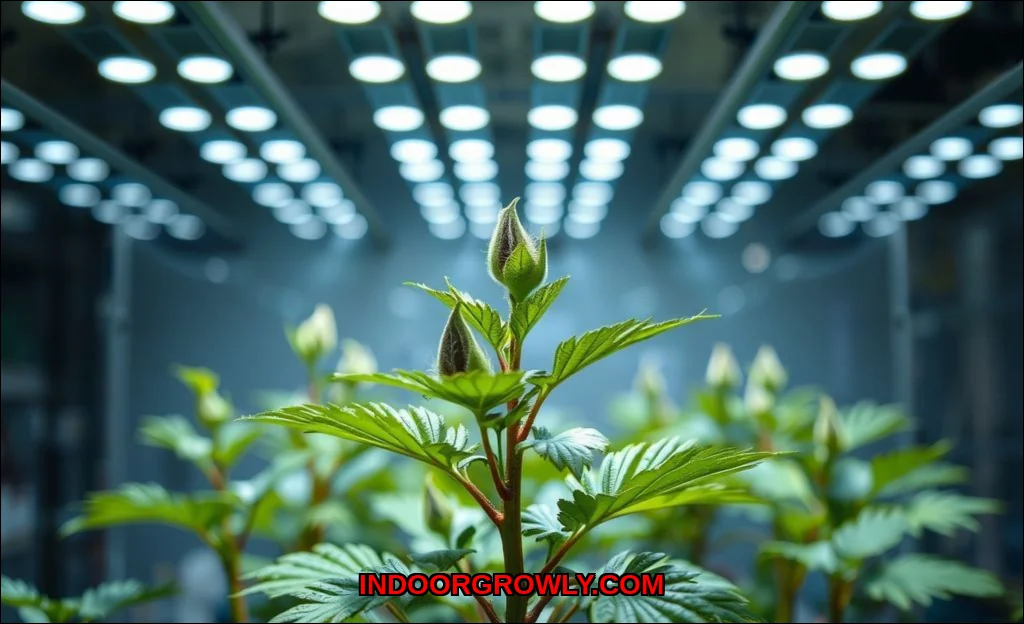
How Light Spectrum Directly Programs Plant Hormones
Plants don’t see light; they sense it through photoreceptors like phytochrome, cryptochrome, and phototropin. Each wavelength triggers a different hormonal response, a process called Photomorphogenesis. During the flowering stage, your goal is to manipulate these responses to favor bud growth over vegetative stretch.
The light spectrum is your primary dial. Heres how key colors work:
- Red Light (660-680nm): This is the primary driver of photosynthesis and flowering. It activates phytochrome, signaling the plant to stop stretching and start flowering. It’s crucial for building bud mass.
- Far-Red Light (720-740nm): This is your secret weapon. In nature, a high far-red light ratio signals sunset or shade. A smart light can use a burst of far-red at “lights out” to trigger a faster sleep transition. This phytochrome response can shorten the night period perception, potentially allowing longer light hours for growth without reverting to veg. It tells stems to stop elongating and redirects energy to bud sites.
- Blue Light (400-500nm): Essential for plant structure and resin production. It keeps internodes tight and stimulates cryptochrome receptors, which influence terpene and cannabinoid synthesis. The blue light ratio during flower should be lower than in veg, but not absent.
A full-spectrum LED that includes these wavelengths gives you the canvas. A smart light lets you paint with them. This precise control is foundational for robust indoor plant health and development.
The Critical Role of Photoperiod: Mimicking Nature with Precision
The Photoperiodthe length of light and dark periodsis the master switch for flowering. While a simple timer can flip this switch, a smart system fine-tunes it. Consistency is non-negotiable. A single light leak or schedule hiccup during the dark period can stress plants, causing hermaphroditism or stalled development.
Smart lights excel here. You can program gradual sunrise/sunset simulations, reducing plant stress. More importantly, you can implement the far-red “end-of-day” signal mentioned earlier. This technique, impossible with a basic timer, effectively shortens the plant’s perceived night, allowing you to squeeze in more photosynthetic hours during the key bulking phase. Its a prime example of how smart tech goes beyond simple automation to active physiological manipulation.
Optimizing Light Intensity (PPFD) for Maximum Bud Growth
Spectrum tells the plant what to do. Intensity provides the energy to do it. This is measured as PPFD (Photosynthetic Photon Flux Density)the number of PAR light photons hitting a square meter each second. Too little, and buds stay airy. Too much, and you get light burn or bleaching.
The expert approach is to manage the Daily Light Integral (DLI)the total amount of PAR light delivered in a day. A common mistake is blasting plants with max intensity from day one of flower. Instead, use your smart light’s dimming function to ramp up PPFD gradually over the first 1-2 weeks of flowering. This allows the plant to acclimate.
Heres a practical PPFD framework for the flowering stage:
| Flowering Phase | Target PPFD Range (mol/m/s) | Smart Light Strategy |
|---|---|---|
| Transition (Week 1-2) | 400-600 | Gradually increase from veg levels. Introduce more red spectrum. |
| Bulking (Week 3-6) | 600-900 | Maintain high, consistent intensity. This is where bud density is built. |
| Ripening (Week 7+) | 500-700 | Slight reduction can help signal final maturation and boost secondary metabolite production like terpenes. |
This answers the question, “does light intensity affect bud density?” Absolutely. Controlled, optimized intensity is key. A quality LED grow light wattage guide can help you select a fixture capable of delivering these PPFD levels at your canopy height.
Beyond Light: Smart Features That Influence the Entire Grow Environment
Smart lights often integrate with broader environmental controls. This is where true optimization happens. Light doesn’t work in isolation.
- VPD & Temperature Sync: Higher light intensity raises leaf temperature. Advanced systems can adjust climate controls in response to light output, maintaining ideal Vapor Pressure Deficit (VPD) for nutrient uptake.
- Data Logging: Track your DLI, spectrum schedules, and yields over cycles. This data is gold for refining your smart grow light schedule for flowering plants.
- Automated Stress Protocols: Some software allows you to program brief, specific light stresses (e.g., UV-B bursts) thought to stimulate resin production, a technique for those wondering how to use smart lights to increase trichome production.
These features move you from passive growing to active plant management. Understanding how light influences leaf development and structure is the first step in this holistic control.
Practical Guide: Setting Up Your Smart Lights for Optimal Bud Formation
Let’s translate theory into action. Follow these steps to program your smart lights for success.
- Establish the Baseline: Use a PAR light meter (or your light’s app map if DLC certified) to measure PPFD at the canopy. Ensure even coverage.
- Program the Photoperiod: Set a strict 12/12 schedule. If your light supports it, add a 10-minute far-red-only period immediately after the main lights turn off to accelerate the sleep cycle.
- Dial in the Spectrum: Select a “flower” or “bloom” mode, or create a custom schedule. Ensure strong red (660nm) dominance, with supplemental far-red and a lower, but present, blue ratio. This is the best light spectrum for bigger buds.
- Ramp the Intensity: Don’t start at 100%. Begin your flowering PPFD at the lower end of the range (e.g., 450 PPFD) and increase by 50-100 PPFD every few days until you hit your target bulking range.
- Monitor and Adjust: Watch your plants. Tacoing leaves or bleaching are signs of too much light. Excessive stretch might indicate not enough blue or too much far-red. Your smart system’s data helps you troubleshoot.
For deeper dives into light science, resources like peer-reviewed research on light quality and plants offer valuable insights.
Smart grow lights are the bridge between basic indoor gardening and true controlled environment agriculture. They transform light from a utility into a surgical instrument. By commanding spectrum, photoperiod, and intensity with precision, you directly influence the hormonal pathwayslike gibberellin and abscisic acid balancethat govern flowering and resin production. You’re not just waiting for buds to form; you’re actively building them, photon by photon. Start with a solid schedule, listen to your plants, and let the data from your smart system guide your refinements. The result will be in the harvest.