
Growing microgreens is a race against time. You have just 7 to 14 days to guide a seed from germination to a nutrient-packed harvest. Every hour counts, and light is your most powerful tool. Standard shop lights can get you started, but to truly optimize for yield, flavor, and nutrition, you need precision. That’s where smart grow lights come in. They move you from simply providing light to actively managing it, turning your indoor farm into a finely tuned system.
Think of smart lights as the conductor of your growth orchestra. Instead of a simple on/off switch, they give you control over the spectrum, intensity, and timing of lightthe key environmental factors that directly shape your crop. For a beginner, a reliable entry point is the Necgemlex Smart LED. It offers app-based control over these critical variables, making it easier to apply the principles we’ll discuss without a massive upfront investment.
What Are Smart Grow Lights and How Do They Differ?
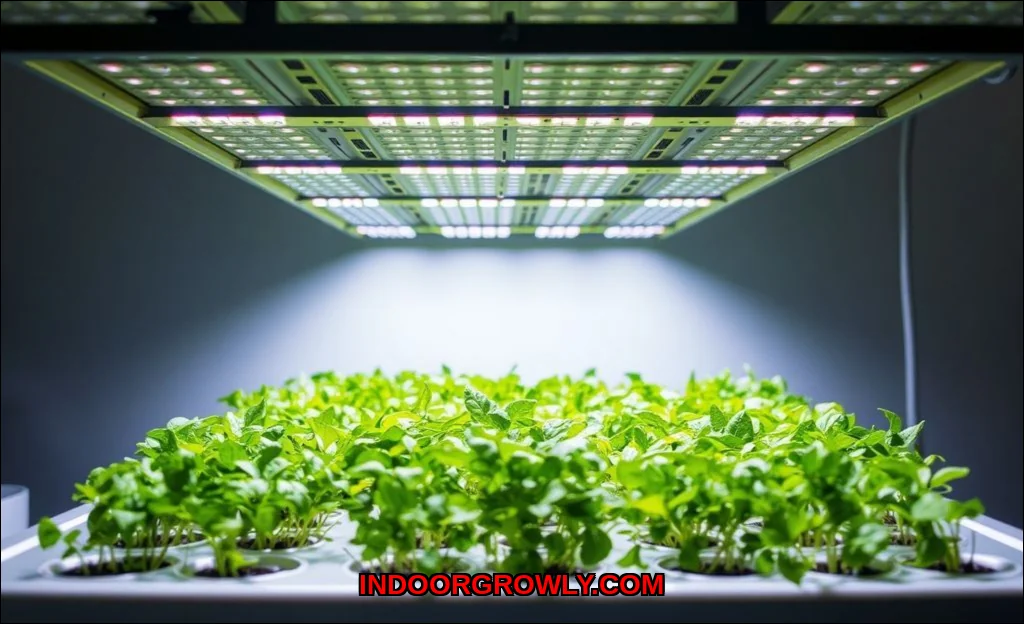
At their core, smart grow lights are LED fixtures with integrated intelligence. Unlike basic LEDs that emit a fixed color and brightness, smart lights are connected and programmable. You control them via a smartphone app or a central controller. This isn’t just a convenience feature; it’s the gateway to programmable lighting and true light intensity control.
The “smart” difference boils down to three capabilities:
- Connectivity: Wi-Fi or Bluetooth links the light to your device.
- Programmability: You can set schedules (photoperiod), adjust brightness, and often change the light spectrum.
- Automation: The system executes your plan perfectly, every day, removing human error.
This shift is a cornerstone of modern indoor farming technology. It allows for sophisticated crop scheduling and turns guesswork into a repeatable process. For a deeper dive into the foundational technology, explore our article on why smart grow lights are pivotal for controlled plant research.
The Science of Light: Why Spectrum and Intensity Matter for Microgreens
Plants don’t see light like we do. They perceive it as a signal for growth and development. For microgreens, this perception is hyper-accelerated. Two scientific concepts are non-negotiable: Photosynthetic Photon Flux Density (PPFD) and Daily Light Integral (DLI).
- PPFD measures how many photosynthetic photons hit a square meter each second. It’s your instant light intensity.
- DLI is the total number of photons delivered over a full day. It’s the cumulative dose that drives growth.
Get the DLI wrong, and your microgreens will be leggy and weak or stunted and slow. Smart lights let you dial in the exact PPFD needed to hit your target DLI for your specific crop cycle.
Spectrum: The Color of Growth
The LED spectrum is where you sculpt your plants’ structure and chemistry. Blue light (400-500 nm) promotes compact, dense growth and boosts chlorophyll production. Red light (600-700 nm) drives stem elongation and leaf expansion. Far-Red light (700-800 nm) influences the Phytochrome Response, affecting germination and shade-avoidance behaviors.
With a full spectrum LED that’s tunable, you can create “light recipes.” Want thicker, darker kale microgreens? Increase the blue. Need more stem length on pea shoots for a better cut? Ramp up the red. This direct manipulation can enhance compounds like anthocyanins (antioxidants) in certain varieties.
Key Benefits of Smart Lights for Your Microgreen Operation
The advantages translate directly to your bottom line and harvest quality.
1. Unmatched Consistency and Automation
Once you find the perfect schedule for a crop, you save it. The lights turn on and off, ramp up and down, and change spectra automatically. This guarantees every tray receives the same Daily Light Integral (DLI), batch after batch. Consistency is the hallmark of a professional operation.
2. Optimized Harvest Yield and Quality
By tailoring the light, you directly influence the harvest. Precise control can lead to heavier cut weights, more vibrant colors, and improved shelf life. You’re not just growing faster; you’re growing better. This is a core principle of Controlled Environment Agriculture (CEA).
3. Significant Energy and Cost Savings
Smart lights are inherently efficient. You can program them to run at lower intensities during certain stages or only during off-peak energy hours. Dimmable drivers prevent you from wasting electricity by over-lighting your trays. Over a year, the savings on your power bill can be substantial, offering a strong cost benefit analysis of smart vs. regular grow lights.
4. Data-Driven Insights for Improvement
Every programmed schedule is an experiment. You can track exactly what light recipe produced your best radish or most flavorful basil. This creates a feedback loop, allowing you to refine your process scientifically. It turns farming into a scalable, data-informed practice.
Practical Features to Look For in a Smart Grow Light
Not all smart lights are created equal. Heres what to prioritize for microgreens:
- Dimmability (0-100%): Essential for adjusting PPFD to hit your target DLI as plants grow.
- Spectrum Tunability: Look for lights that allow you to adjust the ratio of blue, white, and red channels.
- Intuitive App with Scheduling: The interface should make it easy to set complex daily and weekly programs.
- Daisy-Chaining: The ability to link multiple lights to one controller simplifies managing a multi-tray setup.
- Proper Form Factor: For microgreens, a wide, even light bar (like those from Spider Farmer or Mars Hydro) often works better than a single-point light.
Brands like Philips GreenPower lead in commercial research, but excellent consumer options exist. For a comprehensive look at setting up your system, see our guide on how to optimize smart grow lights specifically for microgreens.
Implementing Smart Lighting: A Step-by-Step Guide for Beginners
Ready to upgrade? Follow this practical approach.
- Start with One Light. Test it on a single crop type. The Necgemlex Smart LED or similar is a great starting point.
- Determine Your Baseline DLI. Research your crop. Most microgreens thrive between 12-20 mol/m/day. Use a free PPFD meter app (as a rough guide) or invest in a quantum sensor to measure your light’s output at the canopy.
- Program Your First Schedule. This is where you find the best smart grow light settings for microgreens. A common starting point:
- Photoperiod: 16 hours on, 8 hours off.
- Spectrum: 30% Blue, 70% Red/White for balanced growth.
- Intensity: Adjust PPFD so that (PPFD 0.0036 light hours) = your target DLI.
- Observe and Adjust. Are stems too long? Increase blue light. Growing too slow? Check if your calculated DLI is too low and increase intensity. This process answers how to program lights for faster microgreen growth.
- Scale and Automate. Once satisfied, clone the schedule to other lights for the same crop. Create different programs for different species on your lighting controllers with timers.
Sample Light Schedule for Pea Shoots (Target DLI: 18)
| Growth Day | Photoperiod | Blue % | Red/White % | PPFD Target |
|---|---|---|---|---|
| 1-3 (Germination) | 0 hrs | 0% | 0% | 0 |
| 4-7 | 16 hrs | 20% | 80% | ~312 |
| 8-10 (Harvest) | 18 hrs | 30% | 70% | ~278 |
Remember, your environment is unique. Use this table as a starting template, not a rigid rule.
Beyond the Basics: Expert Insights
The real magic happens when you leverage automation for plant health. Program a 30-minute “sunrise” ramp-up and “sunset” ramp-down. This mimics nature, reducing transplant shock and stress for more resilient plants. If you’re running a multi-variety rack, use zoning features to give delicate herbs less light than vigorous sunflowers, all from one controller.
The question of do smart lights increase microgreen nutrition has a nuanced answer. They don’t create nutrients from nothing. But by optimizing the spectrum and DLI, you can maximize the plant’s genetic potential to produce vitamins, antioxidants, and phytochemicals. You’re removing light as a limiting factor.
For further reading on general grow light science and selection from authoritative horticultural sources, resources like the University of Minnesota’s guide to lighting for indoor plants and the Royal Horticultural Society’s guide on using grow lights offer excellent foundational knowledge.
Smart grow lights are the definitive upgrade for the serious microgreen grower. They transform light from a utility into a strategic tool. You gain control over the pace, shape, and quality of your harvest. The initial learning curve pays for itself in consistent yields, premium produce, and the satisfaction of mastering your environment. Start with one light, experiment relentlessly, and let the data guide your way to a better harvest.