
You love the idea of indoor plants. But your apartment has other plans. North-facing windows, deep overhangs, or simply a lack of windows can turn your urban jungle dreams into a sad display of leggy stems and dropped leaves. The problem isn’t your care; it’s the light. Standard room lighting is designed for human eyes, not plant photosynthesis. This is where technology steps in. For a reliable, user-friendly solution, many urban gardeners turn to options like the Necgemlex Smart LED, which combines the precise light plants need with the convenience modern life demands.
Smart grow lights are the game-changer for low-light apartments. They don’t just provide brightness; they deliver the exact recipe of light your plants crave to thrive, not just survive. Let’s explore why they matter and how they can transform your space.
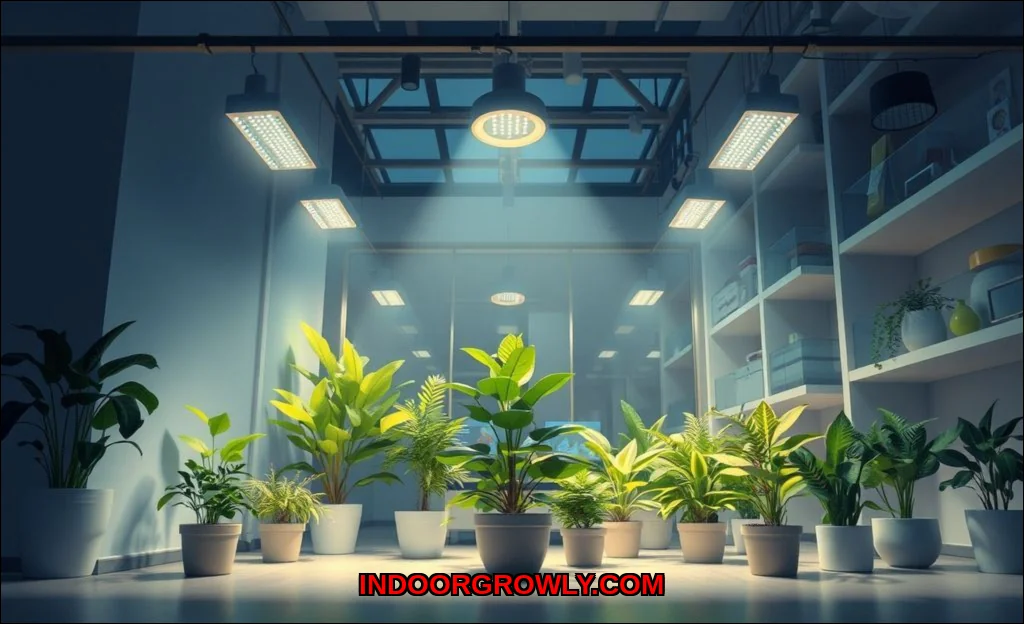
The Science of Light: Why Your Apartment Plants Struggle
Plants don’t see light the way you do. They use specific wavelengths to fuel growth through photosynthesis. In a dim apartment, the core issue is a lack of Photosynthetically Active Radiation (PAR), which is the range of light (400-700 nm) plants can use. A sunny window provides a full, balanced spectrum. Your lamp likely does not.
Two critical concepts explain the struggle:
- Light Spectrum: Plants primarily use blue light for strong stems and lush foliage (the vegetative stage) and red light for flowering and fruiting (the bloom stage). A standard “cool white” LED is heavy in blue but lacks sufficient red, while a “warm white” bulb is the opposite.
- PPFD for Houseplants: This stands for Photosynthetic Photon Flux Density. It’s a measure of how many usable light particles (photons) actually hit your plant’s leaves each second. Your apartment’s ambient light likely has a very low PPFD, far below what most low light apartment plants truly need to flourish.
This light deprivation leads to etiolationplants stretching desperately for any light source, resulting in weak, spindly growth. Herbs become bland, succulents lose their compact form, and seedlings fail entirely.
Beyond Bulbs: What Makes a Grow Light ‘Smart’?
Any LED grow light improves on a standard bulb. But a smart grow light adds a layer of intelligence and control that mimics nature and simplifies your life. It addresses light quality and environmental cues.
The true ‘smart’ advantage is mimicking natural environmental cues. Advanced features like gradual sunrise/sunset simulations and adjustable light recipes (e.g., more blue for foliage, more red for flowering) reduce plant stress and promote healthier growth than simple on/off cycles. This is critical in a consistently low-light environment.
Core Smart Features
- Full Spectrum Grow Light with Adjustable Modes: Unlike a fixed bulb, smart lights often let you switch between dedicated bloom and veg modes. You can give your basil and mint a blue-heavy “veg” spectrum, then switch a flowering plant to a red-enhanced “bloom” mode.
- Automated Light Schedule: The cornerstone of convenience. You set it once via an app, and the light turns on and off automatically, providing consistent, daily “sunlight” even when you’re away. No more forgetting to turn the light on.
- App & Voice Control: Adjust brightness, change spectra, or check schedules from your phone or via voice assistants like Alexa or Google Home. This integrates indoor plant lighting seamlessly into your smart home ecosystem.
- Energy-Efficient LEDs: Modern smart grow lights use highly efficient LED chips. They produce more usable light (PAR) per watt of electricity consumed, saving you money and generating less heata major benefit for small spaces.
Key Benefits for the Urban Gardener
So, what do these features translate to in your apartment? Tangible results.
Grow Anything, Anywhere
Windowless room? No problem. With a proper smart grow light benefits package, you can cultivate a thriving herb garden in your kitchen, grow vibrant lettuces in a closet, or nurture orchids in a dark corner. It unlocks true flexibility for apartment gardening.
Healthier, More Productive Plants
By providing the correct LED grow light spectrum and intensity, you support robust photosynthesis. This means faster growth, more vibrant leaf color, and for edibles like herbs and peppers, significantly improved flavor and yield. You’re not just keeping plants alive; you’re helping them thrive.
Unmatched Convenience with Smart Scheduling
Consistency is key for plants. Smart Scheduling eliminates the guesswork and human error. Your plants get their 12-16 hours of perfect light every single day, automatically. It’s the ultimate set-and-forget tool for a busy lifestyle.
Energy and Cost Savings
A common question is, do smart grow lights use a lot of electricity? Thanks to Energy-Efficient LEDs, the answer is typically noespecially compared to old-school high-intensity discharge (HID) lights. Their precision means you’re not wasting energy on light your plants can’t use. Over time, this efficiency offsets the initial investment.
Choosing the Right Smart Light: A Buyer’s Guide
Not all smart grow lights are created equal. Heres what to look for when searching for the best smart grow lights for dark apartments.
Understand Your Plants’ Needs
Match the light to your garden’s scope. A single strip light is perfect for a shelf of succulents. A larger panel is needed for a tray of seedlings or a flowering plant. Consider these common entities:
- Herbs & Leafy Greens: Require moderate to high light. Look for lights with a strong vegetative (blue) spectrum.
- Succulents & Cacti: Need very high light intensity to maintain compact form. Prioritize lights with high PPFD output.
- Flowering Houseplants (e.g., African Violets): Need a full spectrum that includes ample red light to trigger and support blooms.
- Seedlings: Require intense light placed very close to prevent legginess. Adjustable height is a major plus.
Technical Specifications to Check
| Feature | What to Look For | Why It Matters |
|---|---|---|
| Light Spectrum | Labeled as “Full Spectrum” or “Wide Spectrum.” Adjustable blue/red ratios are ideal. | Ensures your plants get all the wavelengths needed for different growth stages. |
| PPFD/PAR Output | Check the manufacturer’s PPFD map or stated PAR value at various distances. | Tells you the actual usable light intensity reaching your plants. Higher is better for high-light plants. |
| Wattage & Efficiency | Actual power draw (watts), not “equivalent” wattage. Look for modern LED diodes. | Indicates energy consumption. More efficient lights produce more light per watt. |
| Control & Connectivity | Dedicated app, timer functions, sunrise/sunset mode, voice control compatibility. | Defines the “smart” experience and level of automation you’ll enjoy. |
| Form Factor | Bulb, strip, panel, or pendant. Choose based on your space and plant arrangement. | Determines how easily you can integrate the light into your apartment’s decor. |
Brands and Integration
Some brands, like Philips Hue and GE, offer smart bulbs that can be tuned to a grow-friendly spectrum, fitting into your existing lamps. Dedicated smart grow light brands often provide more specialized spectra and higher intensities. Consider how the light fits into your existing smart home setup.
Setting Up for Success: Tips & Best Practices
You’ve chosen your light. Now, let’s talk about how to set up grow lights in a windowless room for maximum effect.
- Hang or Place at the Correct Distance: This is crucial. Follow the manufacturer’s guidelines. Too close, and you risk light burn. Too far, and the PPFD drops dramatically, leading to weak growth. Most lights need to be 6-24 inches from the plant canopy.
- Program a Consistent Schedule: Most houseplants need 12-16 hours of light per day. Use the app to set a consistent daily schedule that mimics a long summer day. A light timer function is your best friend here.
- Use Spectra Strategically: If your light has modes, use the “veg” setting for leafy plants and herbs. Switch to “bloom” when you want to encourage flowers on plants like orchids or peppers.
- Group Plants by Light Need: Place high-light plants (succulents, herbs) directly under the center of the light where PPFD is highest. Lower-light plants (pothos, snake plants) can go towards the edges.
- Monitor and Adjust: Watch your plants. If they’re still stretching, move the light closer or increase the duration. If leaves are bleaching or curling, move it farther away. The light is a tool you fine-tune.
Remember, smart grow lights address the core issue of light quality, not just quantity. A standard lamp provides brightness you can see, but plants require specific wavelengths for photosynthesis and growth stages, which smart lights are engineered to deliver.
Transforming a dim apartment into a lush, green oasis is entirely within your reach. The barrier was never your space, but the light within it. By understanding the science of plant needs and leveraging smart technology, you take control of the environment. You provide consistent, high-quality Photosynthetically Active Radiation (PAR) on a perfect schedule. The result is resilient, vibrant plants that grow with purpose. Start with one light for your favorite herb kit or a struggling succulent. You’ll quickly see the differencenot just in your plants, but in the life they bring to your home.