
Growing long-day plants indoors can feel like a delicate balancing act. You’re trying to replicate the long, bright days of summer to trigger flowering and maximize yield, but with basic equipment, it’s easy to get the light cycle wrong. That’s where precision becomes your greatest ally. For this level of control, many indoor horticulturists turn to integrated solutions like the Necgemlex Smart LED. It combines the necessary spectrum with the automation brains to manage the exacting needs of photoperiod-sensitive plants.
Smart grow lights move far beyond simple illumination. They give you command over the two most critical factors for long-day plants: the precise duration of light (the photoperiod) and the quality of that light (the spectrum). Getting this right isn’t just about growth; it’s about successfully triggering the bloom phase and optimizing your final harvest.
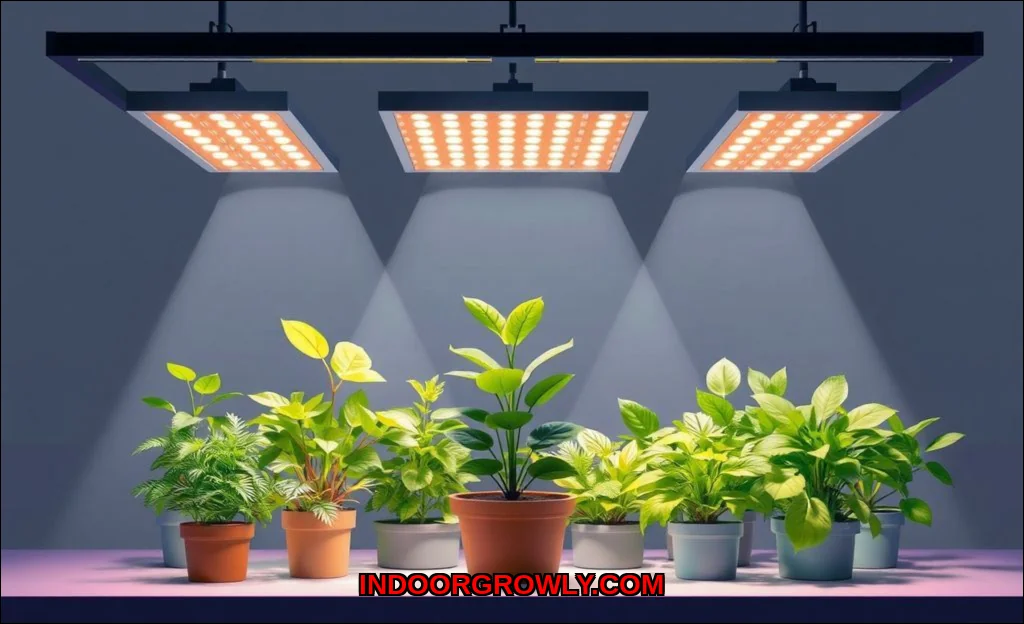
Photoperiodism: The Internal Clock of Long-Day Plants
At the heart of this discussion is photoperiodisma plant’s physiological response to the relative lengths of day and night. Long-day plants (LDPs) like spinach, lettuce, petunias, and many herbs initiate flowering when the night period is shorter than a specific threshold, known as their critical day length. It’s not about a 24-hour cycle of total light, but rather an uninterrupted dark period. A single stray light during this critical dark phase can prevent flowering entirely.
Inside the plant, photoreceptors like phytochrome act as biological light switches. They detect red and far-red light, signaling whether it’s “day” or “night.” Your lighting strategy directly manipulates this system. For a deeper dive into the science behind light-controlled growth, our article on why smart grow lights matter for controlled plant research explores this in detail.
The Core Challenge: Light Duration and Intensity
Your goal is to provide a light cycle that meets or exceeds the plant’s critical day length. For many LDPs, this means providing 14 to 18 hours of light per 24-hour period. But duration is only half the equation. You must also deliver sufficient light intensity.
- PPFD (Photosynthetic Photon Flux Density): This measures the number of photosynthetically active photons hitting a square meter each second. It’s your instant light intensity gauge.
- Daily Light Integral (DLI): This is the total number of photons delivered over a full day. Think of PPFD as the brightness and DLI as the total dose. Hitting the correct DLI is non-negotiable for healthy growth and high yields.
Falling short on DLI, even with the correct photoperiod, leads to leggy, weak plants. Exceeding it can cause light stress and bleaching. It’s a precise science, which is why resources like the University of Minnesota Extension’s guide to lighting indoor plants are so valuable for establishing baselines.
Why Basic Timers and Static Lights Fall Short
A standard mechanical timer and a fixed-spectrum light might seem sufficient. They can turn your lights on and off. But for serious cultivation of long-day plants, they introduce significant limitations and risks.
- Inflexible Photoperiods: Changing the light cycle requires manual adjustment. As your plants transition from vegetative growth to the flowering trigger, you can’t easily create gradual sunrise/sunset simulations.
- Fixed Spectrum: Plants use different light wavelengths at different stages. A static “full-spectrum” light may not optimize the red-heavy spectrum needed to encourage flowering in LDPs.
- No Intensity Control: You can’t dial down the PPFD for seedlings or ramp it up for mature plants without separate hardware. This makes hitting the ideal DLI a guessing game.
- Risk of Human Error: A missed timer setting or a power flicker can disrupt the critical dark period, potentially resetting your plant’s flowering cycle.
How Smart Grow Lights Solve These Challenges
Smart lighting automation transforms these limitations into precise controls. It’s the difference between flipping a wall switch and programming a sunrise in the Alps.
1. Unmatched Precision in Light Cycle Management
You program the exact photoperiod down to the minute via a smartphone app. This ensures the dark period is never accidentally interrupted, safeguarding your flowering trigger. The best systems allow for dynamic “light recipes”gradually increasing intensity at ‘sunrise’ and decreasing at ‘sunset.’ This mimics nature, reducing plant stress and improving growth uniformity compared to the jarring on/off of basic timers.
2. Spectral Tuning for Each Growth Phase
Advanced smart LEDs let you adjust the spectrum. During vegetative growth, you might emphasize blues for compact, leafy development. As you target the flowering phase, you increase red and far-red wavelengths to stimulate bloom initiation and development. This spectral control is a key advantage for optimizing growth even for plants with specific low-light adaptations.
3. Automated DLI and PPFD Delivery
Set your target DLI, and the light can automatically adjust its output over the photoperiod to deliver that exact daily dose. This is a game-changer. It compensates for canopy height differences and ensures every plant gets the perfect amount of Photosynthetically Active Radiation (PAR), maximizing photosynthesis without waste or stress.
4. Data, Control, and Integration
WiFi/Bluetooth controllers provide remote access and monitoring. You receive alerts for schedule changes or issues. Some systems integrate with other environmental sensors, creating a cohesive controlled environment agriculture system. This level of data is invaluable for replicating success and troubleshooting problems.
Key Features to Look for in a Smart Grow Light for Long-Day Plants
Not all “smart” lights are created equal. When selecting a light for photoperiod-sensitive crops, prioritize these capabilities:
| Feature | Why It Matters for Long-Day Plants |
|---|---|
| Programmable Photoperiod | Allows you to set the exact light cycle (e.g., 16/8, 18/6) and change it remotely for different growth stages. |
| Adjustable Spectrum | Enables you to tailor the light recipe, increasing red light for the bloom phase lighting to encourage flowering. |
| Dimmability & Intensity Scheduling | Critical for managing PPFD and hitting the correct Daily Light Integral (DLI) from seedling to harvest. |
| Sunrise/Sunset Simulation | Reduces environmental shock, improving plant health and metabolic efficiency during transitions. |
| Reliable App & Connectivity | Ensures your light duration control schedule is executed without fail, protecting the crucial dark period. |
For a comprehensive look at how these technologies are scaling, the industry analysis on how smart LED grow lights are changing indoor farming offers excellent context.
Putting It All Into Practice
So, what does this mean for your grow? Start by researching your specific plant’s day length requirements. How many hours of light do long day plants need? It varies, but a schedule of 16-18 hours on is a common starting point for many. Use a light meter or your light’s app to measure the PPFD at canopy level and calculate your DLI. Adjust the intensity or duration until you hit the target.
Remember, the best grow light schedule for flowering plants isn’t just longit’s consistent and intense enough. Leverage your smart light’s features to create a gradual ramp-up at the beginning of the day. This eases plants into photosynthesis. When it’s time to trigger flowering, ensure your dark period is pitch black and uninterrupted.
The right technology removes the guesswork from indoor plant cultivation. It gives you the tools to meet the exacting horticultural lighting demands of long-day plants. You’re no longer just providing light; you’re programming an environment. That control translates directly to healthier plants, more reliable flowering, and ultimately, a better yield from your LED spectrum for long day plant projects. Your plants’ internal clocks are counting on it.