
You want strong, sturdy plants, not weak, leggy ones. The difference often comes down to light. Traditional grow lights provide energy, but smart LED grow lights sculpt plant structure with precision. They give you control over the very signals that tell a plant how to grow.
Think of it as moving from a blunt instrument to a sculptor’s tool. By manipulating spectrum, intensity, and timing, you directly influence photomorphogenesisthe process where light dictates form, not just food. This is how you prevent stretching, encourage bushier growth, and build a resilient plant from the ground up. For a practical start, many indoor gardeners find success with a versatile, app-controlled fixture like the Necgemlex Smart LED, which puts this precise control at your fingertips.
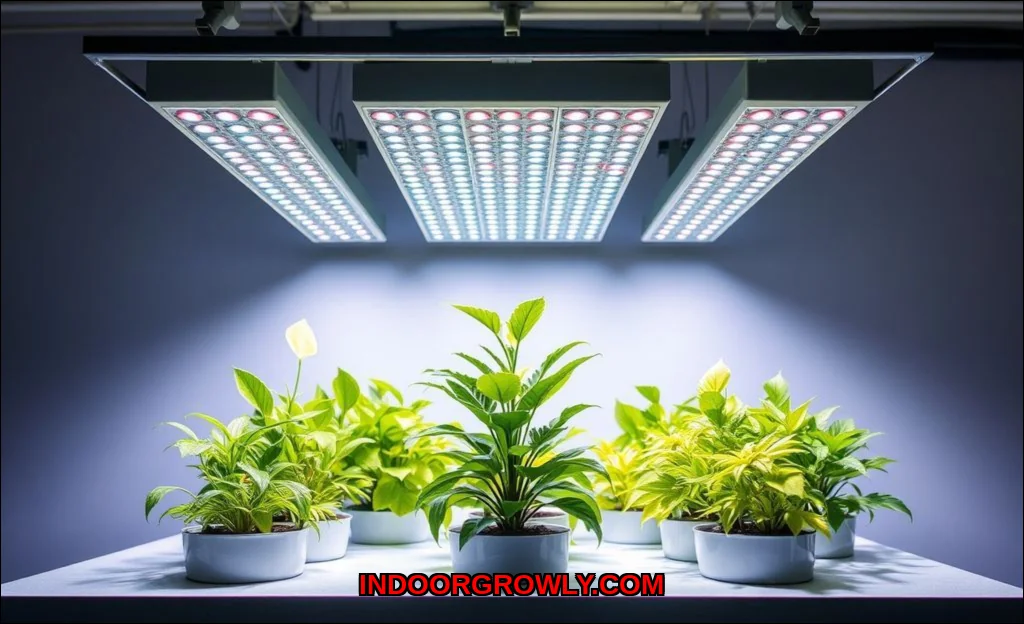
The Science of Light and Plant Form
Plants don’t just see light; they interpret it. Specific photoreceptorslike phytochrome, cryptochrome, and phototropinact as molecular eyes. They detect the quality, quantity, and duration of light, triggering hormonal changes that shape the plant’s architecture. When a seedling stretches desperately for a dim light source, that’s a shade avoidance response mediated by phytochrome. Smart lights let you override these natural, often problematic, reactions.
Your goal is to provide the ideal Daily Light Integral (DLI)the total amount of photosynthetically active radiation (PAR) delivered in a day. Too low, and plants stretch (etiolate). Too high, and you cause light stress or overly compact, stunted growth. Smart systems automate this balance, ensuring consistent, optimal DLI for each growth stage. This foundational control is key to improving overall indoor plant health and vitality.
Precision Spectrum: Beyond Just Red and Blue
While red and blue light drive photosynthesis, the full PAR spectrum tells the plant how to develop. This is where light recipes become powerful. A smart LED grow light lets you adjust spectral ratios to trigger specific structural outcomes.
- Blue Light (400-500nm): Promotes compact, dense growth. It activates cryptochrome, which suppresses stem elongation and encourages thicker, stronger stems and shorter internodal spacing.
- Red Light (600-700nm): Drives photosynthesis and flowering. But its interaction with far-red light is critical for structure.
- Far-Red Light (700-800nm): Often overlooked, it significantly impacts form. A high Red to Far-Red (R:FR) ratio tells the plant it’s in full sun, promoting compact growth. A low ratio mimics shade, triggering stem elongation.
With smart lights, you manipulate the R:FR ratio. For bushier seedlings and vegetative plants, you use a spectrum richer in blue and maintain a high R:FR. This directly answers the search for the best light spectrum for bushier plants.
Key Photoreceptors at Work
| Photoreceptor | Light Sensitivity | Primary Effect on Structure |
|---|---|---|
| Phytochrome | Red & Far-Red | Controls stem elongation, seed germination, and shade avoidance. The Phytochrome Photostationary State (PSS) dictates the plant’s response. |
| Cryptochrome | Blue & UV-A | Inhibits stem elongation, promotes leaf expansion, and influences photoperiod timing. |
| Phototropin | Blue Light | Mediates phototropism (bending toward light) and chloroplast movement for optimal light capture. |
Dynamic Photoperiods and Plant Hormones
Light duration, or photoperiod, is a powerful signal. Using a grow light timer is basic. Smart lights allow for dynamic, automated schedules that sync with plant circadian rhythms and hormonal cycles. For example, a sudden “lights on” can be stressful. Some advanced systems simulate dawn and dusk with gradual intensity ramps, reducing stress for steadier growth.
This automation is crucial for managing hormones like gibberellic acid, which promotes stem elongation. Consistent, automated light schedules for vegetative growth keep hormonal responses predictable, leading to uniform, structurally sound plants. It’s a level of control that standard timers simply can’t match, contributing significantly to the transparency and predictability of your plant growth outcomes.
Intensity & Distance: The Key to Node Spacing
This is where adjusting grow light height for compact growth moves from guesswork to science. Light intensity, measured as PPFD (Photosynthetic Photon Flux Density), drops dramatically with distance. A dimmable smart fixture is essential. Instead of constantly raising and lowering your light, you adjust its power output to maintain the perfect PPFD at a fixed, safe distance that prevents burning.
High intensity at the right distance encourages tight internodal spacingthe gaps between leaves or branches. This creates a stocky, robust plant capable of supporting heavy flowers or fruit. It’s the direct solution for how do smart lights prevent leggy seedlings. You provide intense, consistent light from day one, so the seedling has no need to stretch. Resources from institutions like the University of Minnesota Extension confirm the critical link between light intensity and sturdy plant development.
Managing PPFD and DLI for Structure
- Seedlings: Target a PPFD of 100-300 mol/m/s. High blue spectrum, 18-hour photoperiod. Prevents stretching.
- Vegetative Growth: Ramp up to 300-600 mol/m/s. Maintain high R:FR ratio. Encourages branching and leaf development.
- Flowering/Fruiting: Can increase to 600-900+ mol/m/s for some crops. Adjust spectrum to include more red.
Always calculate your DLI (PPFD x light hours x 0.0036) to ensure you’re in the optimal range for your specific plant.
Data-Driven Optimization for Specific Crops
The ultimate advantage of smart LED grow lights is data. You’re not just setting a static schedule; you’re refining a light recipe based on plant response. This is the frontier of indoor gardening technology.
For herbs like basil, you might use a high-blue recipe with a 16-hour day to create a compact, leafy plant. For a flowering ornamental, you’d transition to a red-heavy spectrum to initiate blooms. This specificity is why commercial growers rely on these systems. The ability to save and replicate “veg” and “flower” programs takes the hassle out of managing different plant growth stages. Research, such as that published in Scientific Reports, continues to refine these crop-specific light formulas, validating the approach for home growers.
Putting It All Together: A Smart Light Checklist
- Full-Spectrum Tuning: Can you adjust blue/red/far-red ratios?
- Dimmability & Automation: Does it have app-based PPFD/DLI scheduling?
- Photoperiod Flexibility: Can you create sunrise/sunset simulations?
- Preset Recipes: Are there programs for seedlings, veg, and bloom?
You build better plants by speaking their language. Light is their primary vocabulary. Smart LED grow lights give you the fluency to command stronger stems, tighter nodes, and balanced architecture. Start with a high-quality, controllable light, dial in a spectrum rich in blue for vegetative vigor, and use automation to deliver consistent intensity. Your plants will respond with a structure that’s not just surviving indoors, but thrivingready to support whatever bounty you aim to grow.