
You’ve invested in a smart grow light. It promises data-driven cultivation. But what exactly is it measuring during the crucial vegetative stage? It’s more than just a timer. These intelligent fixtures track the precise light environment your plants experience, not just what the light emits. This data is your key to steering growth, preventing stretch, and building a robust foundation for flowering.
To leverage this, you need to understand the metrics. A light like the Necgemlex Smart LED can provide a wealth of information, but its value lies in your interpretation. Let’s decode what your smart light is telling you about your vegging plants.
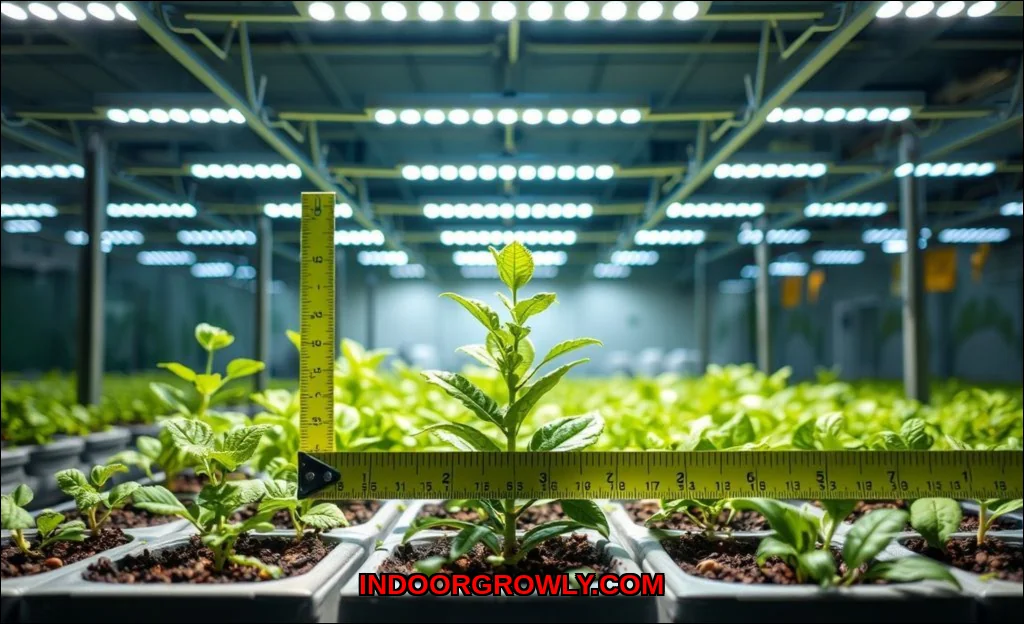
What Smart Grow Lights Actually Measure (The Core Metrics)
Think of your smart light as a plant-centric environmental sensor. It quantifies the light recipe your canopy receives. The core metrics fall into three categories: intensity, quality, and timing. Each interacts to influence plant morphologystem thickness, leaf size, and internodal spacing. Your goal in veg isn’t maximum intensity, but optimal structure. The data guides you there.
Light Intensity: PPFD & DLI – The Power Behind Growth
This is where most growers start. Intensity tells you how much usable light hits your plants.
- PPFD (Photosynthetic Photon Flux Density): This is the instantaneous measurement. It counts the number of photosynthetically active photons hitting a square meter each second (mol/m/s). It’s a spot measurement, like checking the rainfall rate right now. Your smart light’s app often shows a PPFD map. For vegetative growth, a best PPFD for vegetative growth range is typically 300-600 mol/m/s. Lower for seedlings, higher for mature veg plants.
- DLI (Daily Light Integral): This is the cumulative dose. It’s PPFD integrated over your photoperiod, measured in mol/m/day. Think of it as the total rainfall for the day. It’s the ultimate metric for growth potential. For vigorous vegetative growth, target a DLI of 15-25 mol/m/day. Exceeding this can cause light stress, even with perfect spectrum.
A critical expert insight: Smart lights measure light received by the plant, not just light emitted by the fixture. Your hanging height and canopy density dramatically affect the PPFD reading. A light 12 inches away delivers radically more intensity than the same light at 24 inches. This is why how to measure light for veg plants involves checking the canopy level, not the fixture specs.
Light Spectrum (PAR): The Quality of Light for Veg
Not all photons are created equal. Plants use wavelengths from 400-700nm, known as PAR (Photosynthetically Active Radiation). The distribution within this rangethe spectrumacts as a signaling tool.
- Blue Light Ratio (400-500nm): Drives compact, sturdy growth. It promotes chlorophyll production, thickens stems, and reduces internodal stretching. High blue light is a key signal for vegetative development.
- Red Light Ratio (600-700nm): Encourages expansion and elongation. It’s highly efficient for photosynthesis but, in excess during veg, can lead to lanky plants.
- Far-Red & Other Wavelengths: Advanced smart lights may track these. Far-red influences shade avoidance responses and can affect stem elongation.
The spectral balance is crucial. During vegetative growth, you generally want a higher blue light ratio to red light ratiooften in the range of 3:1 to 5:1. This promotes the strong, bushy architecture you need to support heavy flowers later. This focus on light quality is what separates advanced cultivation from simple illumination. For a deeper dive into how spectrum influences development, see our analysis on optimal plant growth curves revealed by smart light data.
What Does a PAR Meter Measure?
It’s a common point of confusion. A dedicated PAR meter measures PPFDthe intensity of PAR light at a specific point. It doesn’t break down the spectrum into blue/red ratios. High-end smart lights with spectral sensors go further, giving you both intensity and quality data from the same device, which is central to effective smart grow light data tracking.
Photoperiod & Environmental Integration
The photoperiodyour light-on scheduleis a simple but powerful metric. For veg, it’s typically 18/6 or 20/4. Smart lights automate this, but the data connection is key. The photoperiod directly calculates your DLI (DLI = PPFD x Light Hours x 0.0036).
leading smart systems can integrate with other sensors, creating a holistic view:
- Environmental Controllers: Data on temperature and humidity can be cross-referenced with light data. High light intensity requires higher VPD (vapor pressure deficit) for optimal transpiration.
- Timing & Scheduling: The ability to automatically adjust intensity or spectrum on a schedule mimics natural conditions and can reduce stress.
How to Use This Data for Healthier Plants
Data is useless without action. Heres how to apply these readings during the vegetative stage.
1. Dial in Intensity for Structure, Not Stress
Use your PPFD map. Don’t just blast seedlings with 600 PPFD. Ramp it up.
- Seedlings/Clones: Start at 200-300 PPFD. Focus on root and initial leaf development.
- Early Vegetative: Increase to 400-500 PPFD. This encourages vigorous leaf growth and branching.
- Late Vegetative / Pre-Flower: You can push to 500-600 PPFD to build photosynthetic capacity, but watch for signs of stress (leaf curl, bleaching). Always check your DLI stays within the 15-25 range.
2. Leverage Spectrum to Guide Morphology
Is your plant stretching with long internodes? Increase the blue ratio in your spectrum. Are plants too compact and dense, risking poor airflow? Slightly increase the red. Use spectrum as a tuning dial. The goal is a plant with strong stems, tight nodes, and ample foliage sites. This principle is a cornerstone of modern improving indoor plant health with smart lighting strategies.
3. Ensure Even Canopy Penetration
A single PPFD reading at the top is not enough. Good canopy penetration ensures lower leaves remain productive. If your light shows a steep drop-off in PPFD just inches below the canopy, you may need to raise the light slightly (to improve spread) or increase intensity (if DLI allows). Alternatively, employ training techniques like topping or LST to create a more even canopy plane.
4. Correlate Light Data with Plant Health Metrics
This is the expert level. Cross-reference your light logs with visual cues.
| Light Metric | Potential Plant Response | Corrective Action |
|---|---|---|
| DLI too high (>25) | Leaf bleaching, crispy edges, heat stress | Reduce intensity or shorten photoperiod |
| DLI too low (<15) | Stretching, slow growth, pale leaves | Increase intensity or lengthen photoperiod |
| Blue ratio too low | Excessive stem elongation, weak structure | Adjust spectrum setting toward “veg” or “blue” |
| Uneven PPFD spread | Asymmetric growth, lower leaf senescence | Adjust light height/angle or train canopy |
Your smart light provides the numbers. You provide the context. The plant provides the feedback. This loop is how you optimize. For broader perspectives on light selection and application, resources from institutions like the University of Minnesota Extension on lighting for indoor plants and research on light quality and plant physiology from Frontiers in Plant Science reinforce these data-driven principles.
Putting It All Together
Smart grow lights transform you from a passive observer to an active director of growth. During vegetation, you’re the architect. PPFD and DLI are your measures of construction strength. The PAR spectrum, specifically the blue-red balance, is your blueprint for form and structure. Photoperiod and integrated data provide the schedule and site conditions.
Start by focusing on one metric at a time. Master DLI targets first. Then experiment with spectral adjustments. Log your settings and observe the plant’s response. The data from your smart light isn’t just for showit’s the most direct conversation you can have with your crop. Listen to it, interpret it, and you’ll build plants capable of incredible yields.