
Growing leafy greens indoors gives you complete control over their environment. The most powerful tool at your disposal is light. While any grow light helps, a smart grow light transforms your setup from manual guesswork to a precision instrument. You can dial in the exact conditions your lettuce, kale, or spinach needs to thrive.
Think of light not just as illumination, but as a growth signal. Every aspectcolor, duration, and intensitydirects plant development. For a simple, reliable start, many indoor gardeners use a programmable timer like the BN-LINK BND-60U47 Indoor to automate the photoperiod. It’s a foundational step toward the dynamic control that true smart lighting offers.
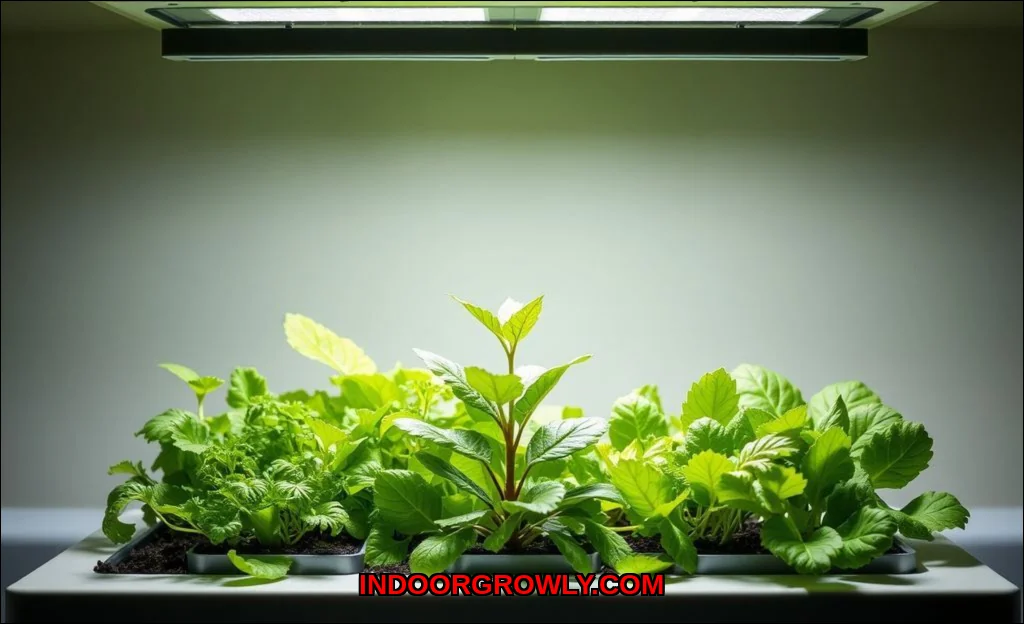
Light as Your Primary Growth Variable
In a controlled environment, you replace the sun. This means you must manage all its components intentionally. The three pillars of lighting for plants are spectrum (color), photoperiod (day length), and intensity (brightness). Getting these right for leafy greens means promoting lush, compact, and fast vegetative growth instead of leggy, stressed, or bitter plants.
Your goal is to provide the optimal Daily Light Integral (DLI)the total number of light particles (photons) delivered in a day. Different greens have different DLI “appetites.” Exceed it, and you waste energy or cause stress. Fall short, and growth stalls. Smart modes handle this math for you.
The Core Smart Modes for Leafy Greens
Modern smart lighting systems offer pre-set and customizable modes. For greens, you’re looking for features that prioritize vegetative development and leaf quality.
1. Spectrum Optimization: Crafting the Perfect Light Recipe
The LED spectrum is your first dial to turn. While full-spectrum white lights are common, the real magic is in tuning the ratios. For leafy greens like lettuce and kale, a spectrum rich in blue (400-500nm) and red (600-700nm) light is key.
- Blue Light: Promotes compact, sturdy growth, thickens leaves, and regulates stomatal opening. It’s crucial for preventing leggy seedlings.
- Red Light: Drives photosynthesis and biomass accumulation. It encourages larger leaves and faster growth.
An expert insight: Increasing blue light can enhance pigment concentration, like boosting anthocyanins in red lettuce or deepening the green in spinach. This is the foundation of specific light recipes used by commercial brands like Philips GreenPower or Fluence Bioengineering. You’re essentially choosing the best light spectrum for lettuce growth versus one optimized for fruiting plants.
2. Programming the Photoperiod: Mimicking and Manipulating Nature
The photoperiod is simply how long your lights are on each day. Most leafy greens are “day-neutral” for flowering but have a vegetative sweet spot.
- Standard Growth: A 16-18 hour “day” is typical for vigorous vegetative growth.
- Energy Saving/Propagation: You can run 12-14 hours for slower-growing greens or to harden off seedlings.
- Advanced Tactics: Some growers use a 6-hour on / 2-hour off cycle repeated to stress plants mildly, which can increase certain phytochemicals.
Smart systems let you create sunrise/sunset ramps and complex weekly schedules automatically. This is the heart of how to program grow lights for kale or an automated light schedule for microgreens.
3. Managing Intensity & DLI for Optimal Yield
This is where smart lights truly shine. Intensity is measured as Photosynthetic Photon Flux Density (PPFD)how many photons hit a square meter each second. DLI is PPFD multiplied by time.
Your PPFD requirements for spinach indoors (around 200-400 mol/m/s) differ from arugula’s. A static light at a fixed height can’t adapt. A smart light with a built-in PAR sensor can.
Heres the expert move: The true benefit is dynamic DLI management. Your lights can automatically increase intensity on a cloudy day or as the plant canopy thickens. This maintains a consistent, optimal daily light sum. No more leggy growth from low light. No more bleached tips from light stress. It’s automated precision.
Consider this table for common leafy greens:
| Plant | Target DLI (mol/m/d) | Typical PPFD Range (mol/m/s) |
|---|---|---|
| Lettuce | 12-17 | 150-300 |
| Spinach & Kale | 15-20 | 200-400 |
| Microgreens | 8-12 | 100-250 |
| Arugula | 10-15 | 150-300 |
4. Integrating Automation for Set-and-Forget Success
This ties everything together. A fully automated system uses sensors and programming to execute growth cycles. You set the parameters for each stageseeding, vegetative growth, and harvestand the system adjusts spectrum, photoperiod, and intensity accordingly.
This is a game-changer for succession planting. While one tray of lettuce is on a high-intensity vegetative schedule, your newly seeded microgreens can be under a gentler, bluer spectrum. It all runs simultaneously. For a deeper dive into how these cycles work, explore our guide on what smart grow lights reveal about optimal growth curves.
Putting It All Into Practice
Start with your plants’ known DLI and spectrum needs. Use your smart light’s app to create a program. Begin with a moderate intensity and watch how your greens respond over 3-4 days. Are they stretching? Crank up the blue and the PPFD. Are they showing stress? Dial it back.
Remember, plants adapt. The static settings you used for seedlings won’t be optimal for a mature canopy. This is why understanding what smart grow lights indicate about plant adaptation limits is so valuable. Your lighting should evolve as they do.
For broader context on lighting technology, resources from university extensions like the University of Minnesota and practical guides from Epic Gardening offer excellent foundational knowledge.
Beyond the Basics: Spectral Quality and Efficiency
The discussion goes beyond just red and blue. Far-red radiation (700-800nm) can influence leaf expansion and stem elongation. UV light can trigger defense mechanisms, potentially increasing nutrient density. The spectral quality of your fixturehow accurately and evenly it delivers these wavelengthsmatters. High-end brands like Gavita invest heavily in this engineering.
This precision also drives energy efficiency. By delivering only the light your plants need, when they need it, you minimize waste. Your smart system isn’t just growing better greens; it’s growing them more sustainably.
Mastering smart grow light modes turns you from a gardener into a plant physiologist. You’re no longer just providing light; you’re crafting a dynamic, data-driven environment. You’ll see the results in the crunch of your romaine, the depth of color in your red kale, and the consistent, rapid yields from every harvest. Start with one automated program. Observe, tweak, and watch your leafy greens respond like never before.