
You want bigger harvests from your indoor garden. The right smart grow light is your most powerful tool to achieve that. It’s not just about brightness anymore. Modern horticultural lighting is about delivering the precise light recipe your plants need, when they need it, across every leaf.
Think of it as moving from a simple on/off switch to a fully programmable climate controller for light. The best features directly address plant photobiology. They automate the complex interplay of spectrum, intensity, and timing that drives photosynthesis and morphology. For a balanced, user-friendly option that packs these smart features, many growers have success with the Necgemlex Smart LED. It exemplifies how integrated controls can simplify yield optimization.
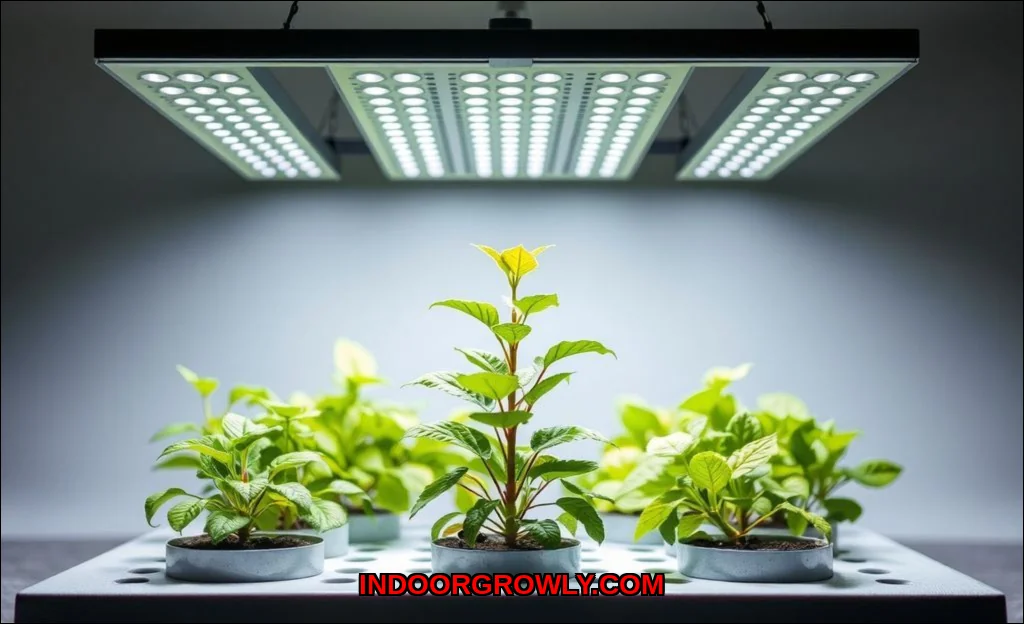
The Foundation: How Plants Use Light
Before diving into features, you need a quick primer on the language of light. Plants don’t see light; they absorb photons to fuel growth. The key metrics are Photosynthetic Photon Flux Density (PPFD) and Daily Light Integral (DLI).
- PPFD measures the number of photosynthetically active photons hitting a square meter each second (mol/m/s). It’s your instant light intensity at the canopy.
- DLI is the total number of photons delivered over a full day (mol/m/day). It’s the cumulative dose. Different crops have specific DLI requirements for optimal growth.
Photosynthetically Active Radiation (PAR) is the wavelength range (400-700nm) plants use. Your goal is to manage the DLI by adjusting PPFD and photoperiod (light hours). This is where smart features become indispensable. As an expert insight: true yield optimization comes from managing the DLI, not just the photoperiod. A smart light that can automatically adjust intensity to hit a target DLI is far superior.
Core Feature 1: Tunable Spectrum & Light Quality
Fixed “full-spectrum” white LEDs are a good start. But a tunable spectrum lets you mimic the sun’s seasonal changes and target specific plant responses. This is a game-changer for plant growth optimization.
Why Spectrum Matters
Different wavelengths trigger different physiological processes. A smart light with channel control lets you dial in these effects.
- Blue Light (400-500nm): Promotes compact, sturdy vegetative growth. It’s crucial for preventing leggy seedlings.
- Red Light (660nm): The engine of photosynthesis. It drives flowering and fruiting. The ratio of red to far-red light (R:FR) directly influences stem elongation and flowering time.
- Far-Red (730nm): Often overlooked. It can trigger the shade avoidance response, but used strategically at the end of a light cycle, it can speed up flowering (a trick known as the “end-of-day far-red pulse”).
- UV/IR Supplementation: Small amounts of UV can stimulate the production of oils, resins, and antioxidants. IR influences leaf temperature and transpiration.
With tunable channels, you can create the best light spectrum for flowering stage (heavy red) and then switch to a more blue-rich recipe for vigorous vegetative growth in your next crop cycleall from an app.
Core Feature 2: Precise Intensity & Uniformity Control
This is arguably the most critical hardware feature. Delivering the right PPFD is useless if it’s uneven. Hotspots cause light stress and bleaching. Dark spots stunt growth. Both are yield thieves.
The most impactful ‘smart’ feature is the light’s ability to deliver a spatially uniform PPFD map. No schedule can fix poor hardware design. Look for fixtures with optimized lens technology and diode layout that promise high Photon Efficacy (more light per watt) and even coverage.
Mastering DLI with Dimming
High-quality 0-100% dimming is non-negotiable. It allows you to:
- Precisely set PPFD for different growth stages without changing hanging height.
- Automatically adjust intensity to maintain a perfect DLI as plants grow closer to the light.
- Prevent shocking young seedlings or clones with full intensity.
This precision is key for solving problems like how to calculate DLI for tomatoes. Once you know your target DLI (e.g., 30 mol/m/day for fruiting tomatoes), your smart system can help maintain it by adjusting intensity over the photoperiod.
Core Feature 3: Intelligent Automation & Scheduling
This is the “smart” in smart grow light. Automation ensures consistency, the holy grail of indoor farming. Forget manual timers.
- Sunrise/Sunset Simulations: Gradually ramping intensity up and down reduces plant stress, mimicking nature.
- Stage-Based Programs: Set a “seedling” schedule (18 hours, lower intensity, bluer spectrum) that automatically transitions to a “flowering” schedule (12 hours, higher intensity, redder spectrum) after a set number of weeks.
- Cloud Connectivity: Control your lights from anywhere, receive alerts, and monitor run-time data.
These features make creating automated light schedules for seedlings effortless. You set it once, and the system executes perfectly every time, ensuring your plants get the perfect start. This level of control is a core advantage in the smart grow light vs regular LED debate. For a deeper look at how these schedules influence plant biology, consider what smart grow lights reveal about plant adaptation limits.
Core Feature 4: Environmental Sensing & Data Integration
The most advanced systems don’t operate in a vacuum. They integrate with other climate factors. This is the frontier of indoor farming technology.
Some smart lights include built-in sensors or connect to external ones to monitor:
| Sensor Type | What It Measures | Impact on Yield |
|---|---|---|
| Light Sensor | Canopy-level PPFD | Ensures your setpoints are actually delivered; enables closed-loop DLI control. |
| Temperature/Humidity | Microclimate at canopy | Allows light intensity to be adjusted if leaf temperature gets too high (VPD management). |
| CO2 | Carbon Dioxide levels | Can trigger higher light intensities only when CO2 is sufficient to support boosted photosynthesis. |
This data integration creates a true growth optimization system. The light becomes an active player in the grow room environment, reacting to real-time conditions to maximize photosynthetic efficiency while preventing stress. This holistic approach is key to how smart grow lights improve indoor plant health beyond simple illumination.
Putting It All Together for Maximum Yield
Choosing a smart light isn’t about one flashy feature. It’s about how these systems work together to remove guesswork and bottlenecks.
Start with a fixture known for excellent light uniformity and high efficacy. Then, prioritize a system that gives you granular control over the light spectrum and light intensity. Ensure its automation can handle complex, stage-based scheduling. Finally, consider its potential to integrate with sensors for future expansion.
You consistently hit the ideal Daily Light Integral (DLI) with the perfect spectral quality, uniformly across every plant. You eliminate light-related stress. You automate tedious tasks. Your energy is spent on other aspects of plant care. This coordinated approach, enabled by horticultural lighting intelligence, is what translates directly into a measurable yield increase. For broader context on selecting fixtures, reputable guides from sources like the University of Minnesota Extension and the Royal Horticultural Society reinforce these core principles of plant photobiology.
Your harvest weight is a direct product of the photons your plants capture and use efficiently. Smart grow light features are the levers you pull to maximize that capture. Use them wisely.