
You’ve probably noticed your indoor plants behave differently under artificial light. They might stretch toward a window or grow leggy and weak. Traditional grow lights offer a fixed spectrum and schedule, which is a bit like feeding your plants the same meal every day. Smart grow lights change that entire equation. They give you precise, programmable control over the light environment, allowing you to directly influence plant habits in ways that were once only possible in advanced labs.
This isn’t just about brightness. It’s about manipulating the fundamental signals plants use to grow. With a smart system, you’re not just providing energy for photosynthesis. You’re actively steering photomorphogenesisthe way plant form develops in response to light. For a practical start, many home gardeners find success with a versatile, app-controlled option like the Necgemlex Smart LED. Its tunable spectrum lets you experiment with the concepts we’ll discuss.
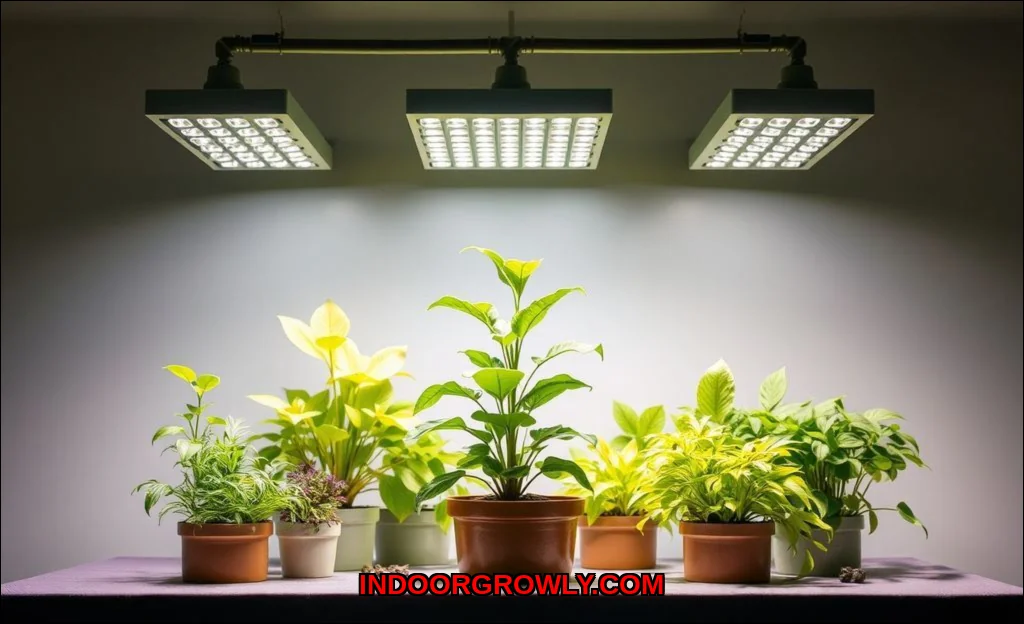
How Smart Lights Differ from Traditional Grow Lights
Think of the upgrade from a basic fluorescent to a smart LED as moving from a manual transmission to a self-driving car. The core functionproviding lightis the same. But the level of control, feedback, and optimization is worlds apart. Traditional lights offer a static output. You turn them on and off, maybe with a simple timer. Their spectrum is fixed, often heavy in just blue or red wavelengths.
Smart grow lights, typically full-spectrum LEDs, are dynamic. You control them via an app or controller. This programmability centers on three key variables:
- Light Spectrum (Quality): You can adjust the ratio of blue, red, far-red, and other wavelengths in real time.
- Light Intensity (PPFD): You dial in the photosynthetic photon flux density, the number of light particles hitting your plant canopy each second.
- Photoperiod Control: You create complex sunrise/sunset simulations or stage-specific light schedules that run automatically.
This trifecta allows you to mimic ideal seasonal conditions or create entirely new ones to trigger specific plant growth stages. It’s the foundation for changing plant habits on demand.
Key Plant Responses to Programmable Light Spectra
Plants “see” light differently than we do. They use photoreceptors like phytochrome and cryptochrome to detect specific colors and ratios. By changing your smart light’s LED spectrum, you send direct biochemical instructions to your plants.
Controlling Shape and Stretch
One of the most dramatic changes you’ll see is in stem elongation and leaf size. High levels of blue light promote compact, bushy growth. It strengthens cell walls and suppresses stem elongation (internode distance). This is perfect for preventing seedlings from getting “leggy.” Conversely, a higher ratio of red to far-red light influences the phytochrome response. Plants interpret a low Red:Far-Red (R:FR) ratio as being in the shade of other plants. They trigger a shade avoidance response: stretching stems, larger leaves, and reduced branching to reach light.
Expert Insight: Smart lights allow for the precise manipulation of the Red:Far-Red (R:FR) ratio, which directly controls stem elongation and shade avoidance responses, reducing ‘leggy’ growth common in indoor settings. You can literally program a spectrum that tells your plant, “Grow compact and strong.”
Steering Growth Stages
This is where you answer questions like how does blue light affect plant growth indoors and what’s the best light spectrum for flowering plants under smart lights.
- Vegetative Growth: A spectrum richer in blue (e.g., 30% blue) encourages tight nodal spacing, robust leaf development, and strong apical dominance. It’s ideal for leafy greens and building a sturdy plant structure.
- Flowering & Fruiting: Shifting to a spectrum with more red and far-red light (e.g., moving from a 18/6 light schedule to 12/12 with a red-heavy spectrum) signals the plant to initiate flowering. Far-red light can also help with flower expansion. This precise spectral steering is key to improving yield and quality.
You’re not just waiting for a plant to flower; you’re telling it to flower by changing the light recipe. This deeper level of control is a core part of how smart grow lights improve indoor plant health at a physiological level.
Optimizing Growth Stages with Automated Photoperiods
Photoperiodisma plant’s response to day lengthgoverns flowering, bulb formation, and dormancy. Smart lights automate this with incredible precision. You can create a 14-hour “day” for your lettuce and a strict 12-hour “day” for your chrysanthemums in the same room, with automatic sunrise ramping to reduce plant stress.
The most critical metric here is the Daily Light Integral (DLI). DLI is the total number of photosynthetic photons delivered to your plant over a 24-hour period. It’s the cumulative dose of light. Different species have specific DLI requirements for optimal growth.
Expert Insight: By automating the Daily Light Integral (DLI), smart systems can deliver the exact cumulative photons a specific plant species needs per day, optimizing growth while preventing light stress or deficiency more accurately than manual timers. The system can adjust intensity or duration to hit a precise DLI target, even if a cloudy day affects your ambient light.
This automation directly addresses long-tail questions like can smart lights reduce plant stretching and do smart grow lights improve plant yield. The answer is yes, by ensuring consistent, optimal light energy (DLI) and the correct photoperiodic signals without human error.
Energy Efficiency and Plant Health Trade-offs
It’s a common myth that running smart LEDs is always more expensive. Their efficiency lies in precision. You’re delivering the exact light intensity (measured in PPFD) and spectrum needed, exactly when it’s needed. This avoids wasting energy on excessive light or incorrect spectra that the plant can’t use effectively.
However, there’s a key trade-off to manage: light stress. Pushing PPFD too high to maximize growth can overwhelm a plant’s photosynthetic machinery, causing bleaching or nutrient lockout. The plant’s stomata (pores) may close to conserve water, which also halts CO2 intake. Smart systems help mitigate this through dimming and scheduling, but you must still understand your plant’s limits. For a deeper dive into those boundaries, consider what smart grow lights indicate about plant adaptation limits.
| Factor | Traditional Light | Smart Grow Light |
|---|---|---|
| Energy Use | Often high (HPS) or inefficient (Fluorescent) | High efficiency LED, used only as needed |
| Heat Output | Can be very high, affecting leaf temperature | Generally low, reducing transpiration stress |
| Stress Potential | High if too close/fixed spectrum | Programmable to minimize stress |
| Long-term Plant Health | Can promote weak, stretched growth | Promotes natural, robust habits |
Practical Implementation Tips for Home Growers
Ready to change your plants’ habits? Start with these steps.
- Know Your Plant’s DLI: Research the ideal Daily Light Integral for your specific plant. A low-light fern needs a DLI of 4-6, while a tomato seedling wants 20-30. Use a PPFD meter app (or your light’s app data) to calculate it: (PPFD x Light Hours x 0.0036).
- Start with Presets, Then Experiment: Most smart lights have “Veg” and “Bloom” modes. Use them as a baseline. Then, try increasing blue by 10% during early vegetative growth to see if your plants become more compact.
- Automate Photoperiods Seasonally: For perennial plants or herbs you keep year-round, create longer “summer” days and shorter “winter” days to support their natural cycle, perfect for overwintering plants.
- Monitor and Adjust: Watch for signs of stress (bleaching, curling) or stretch. Adjust intensity or spectrum incrementally. Plant habits will tell you if your light recipe is working.
For broader guidance on selecting equipment, trusted resources like the University of Minnesota Extension’s guide to lighting indoor plants and the Royal Horticultural Society’s grow light advice offer excellent, science-based foundations.
Your Plants, On Your Terms
Smart grow lights shift you from a passive observer to an active director of your indoor garden. You’re no longer limited by a fixed bulb. You can program compact growth for herbs on a kitchen counter, trigger prolific flowering in an orchid, and start seedlings with unprecedented vigorall by understanding and manipulating light. The changes in plant habitsfrom stem thickness to flower timingbecome a direct reflection of your inputs. It turns indoor gardening into a dialogue with your plants, where you provide the precise signals, and they respond with optimized growth. Start with one adjustable variable, observe the habit change, and go from there. The control is literally at your fingertips.