
You’re no longer just giving your plants light. With smart grow lights, you’re giving them a language they understand. These advanced systems let you communicate directly with a plant’s biology, triggering specific behaviors on demand. It’s a shift from passive illumination to active cultivation. You can now influence everything from stem length to flowering time, all from your smartphone.
This control stems from manipulating Photomorphogenesisthe process where light directs plant growth and development, separate from photosynthesis. Plants don’t just see “brightness.” They perceive color, intensity, duration, and direction through specialized photoreceptors like phytochrome and cryptochrome. A smart light lets you speak to these receptors. For a hands-on start, many indoor gardeners find success with a system like the Necgemlex Smart LED, which offers app-controlled spectrum and scheduling to experiment with these concepts.
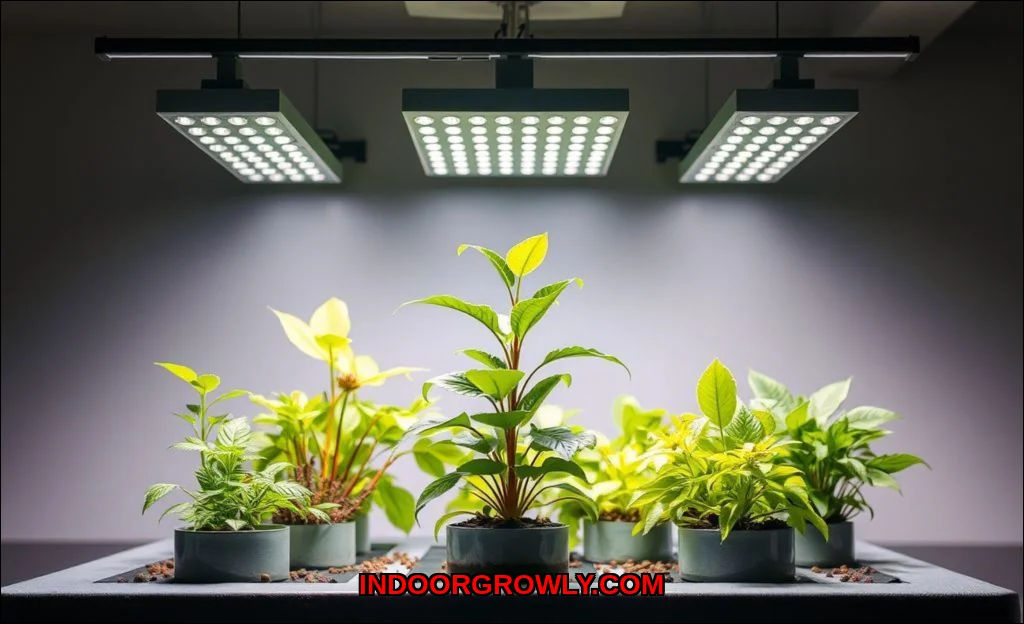
How Smart Lights Trigger Specific Photomorphogenic Responses
Your plants are constantly interpreting light signals. Smart LEDs allow you to become the author of those signals. By adjusting the light spectrum, you directly influence which photoreceptors are activated and what message is sent. This is the core of smart grow light effects.
Consider phototropism, the growth toward light. While basic lights cause a slow bend, smart lights with adjustable intensity can manage this response more evenly. More critically, you can manipulate the Shade Avoidance Response. In nature, plants sensing more far-red light (reflected from competitors) stretch to outgrow neighbors. Indoors, this creates “leggy,” weak plants. With a smart light, you can minimize far-red and increase red light, suppressing this stretch signal. Compact, sturdy plants perfect for limited spaces.
This level of control means you’re not just growing plants; you’re designing their architecture. As explored in our article on what smart grow lights indicate about plant adaptation limits, this technology reveals how precisely we can now guide growth.
Key Photoreceptors and Your Light Recipe
- Phytochrome (Red/Far-Red Sensor): Controls seed germination, flowering, and the shade avoidance response. A high red to far-red ratio promotes compact growth.
- Cryptochrome & Phototropin (Blue/UV-A Sensors): Mediate blue light compact growth, stomatal opening, and phototropism. Essential for keeping seedlings and leafy greens dense.
Optimizing Spectrum: From Seedling to Harvest
The concept of a fixed “full spectrum” is outdated. A true Dynamic Light Recipe changes with your plant’s life stage. This is light spectrum plant growth management at its finest.
Seedling & Vegetative Stage: Building Structure
How does blue light from smart LEDs affect seedlings? Profoundly. Higher blue spectrum percentages activate cryptochrome, which inhibits cell elongation. This results in shorter internodal spacing and thicker stems. You get robust, bushier plants from the startthe perfect answer for using smart lights to prevent leggy growth in herbs like basil and cilantro.
Flowering & Fruiting Stage: Driving Production
Here, red and far-red wavelengths become crucial. Phytochrome triggers the metabolic shift into reproductive mode. Increasing red light boosts flowering and fruiting energy. A precise touch of far-red at the end of a light cycle can even mimic sunset, potentially speeding up flowering. This leads to the common query about the best light schedule for flowering with programmable LEDs, which hinges on manipulating these spectra daily.
The ultimate goal for many is yield. So, does adjustable spectrum increase yield in indoor vegetables? Research and practice say yes. Tailoring the spectrum reduces wasted energy on unwanted behaviors (like stretching) and directs more resources into edible biomass. For deeper insights on plant health under this tailored light, see our guide on how smart grow lights improve indoor plant health.
Automating Growth Cycles with Light Schedules and Intensity
Beyond color, smart lights excel in delivering precise light quantity. This is where PPFD and DLI control becomes your most powerful tool.
- PPFD (Photosynthetic Photon Flux Density): Measures light intensity (photons per second) at a specific point. Your smart light can adjust this intensity automatically at different times of day or for different canopy heights.
- Daily Light Integral (DLI): The total number of photons delivered per day. This is the plant’s daily “light budget.”
You can program your system to deliver the exact DLI a specific crop needs. A tomato seedling needs less than a mature flowering plant. A smart system automatically adjusts intensity and photoperiod to hit that target DLI every single day, regardless of cloud cover or season. This is automated light schedules working with biology, not just a timer.
| Growth Stage | Spectrum Focus | DLI Target (mol/m/d) | Smart Light Behavior |
|---|---|---|---|
| Seedling / Propagation | Higher Blue (30-40%) | 6-12 | Lower intensity, 18-24 hr photoperiod |
| Vegetative | Balanced Blue & Red | 12-25 | Ramping intensity, 16-18 hr photoperiod |
| Flowering / Fruiting | Higher Red & Far-Red | 20-40+ | Peak intensity, 12 hr photoperiod, sunset simulation |
Managing Plant Stress and Energy Consumption
Smart lighting is as much about prevention as promotion. You can use light to preemptively manage stress. Gradual “sunrise” and “sunset” ramps prevent thermal and photonic shock. You can also use specific spectra to bolster plant defenses; for example, low levels of UV can trigger protective antioxidant production in some species.
On your utility bill, the LED light plant response is beautifully efficient. Automating DLI means lights only use the energy needed to hit the photon target. No more running at 100% power for 16 hours if the plants are saturated by hour 14. This dynamic adjustment, often based on integrated light sensors, cuts significant energy waste. You optimize growth and cost simultaneously.
The Future: Data-Driven Cultivation with Smart Systems
The next evolution integrates environmental sensors. Your smart lights won’t operate in a vacuum. They’ll react to data from humidity, temperature, and CO sensors. Imagine the lights temporarily reducing intensity when humidity drops too low to slow transpiration, all automatically.
This creates a closed-loop, data-driven grow environment. The system learns and adapts, refining the Dynamic Light Recipe in real-time for your specific space and plants. It moves from preset programs to true adaptive cultivation. For a broader look at this technological shift in agriculture, resources like this analysis on smart LED grow lights in indoor farming provide excellent context.
You’re not just flipping a switch anymore. You’re conducting an orchestra of photoreceptors. By understanding and manipulating Photomorphogenesis and Daily Light Integral (DLI) with smart technology, you gain an unprecedented level of control. You dictate shape, pace, and output. Start with one adjustable spectrum, experiment with a schedule, and observe the direct plant behaviors change under smart grow lights. The plants are listening. Now you have the vocabulary to speak.