
You want to know if your plants need water. Guessing is stressful. A soil moisture sensor takes the uncertainty out of watering, whether you’re tending a windowsill herb garden or managing a small farm. But with so many types on the market, choosing the right one can be confusing. This guide cuts through the noise.
We’ll compare the core technologies, from simple analog probes to advanced wireless networks. You’ll learn what makes a sensor accurate, where to place it, and how to connect it to a smart irrigation controller. For a straightforward, affordable start, many home gardeners find success with the XLUX Soil Moisture meter. It’s a classic resistive sensor that gives you a quick, no-frills reading.
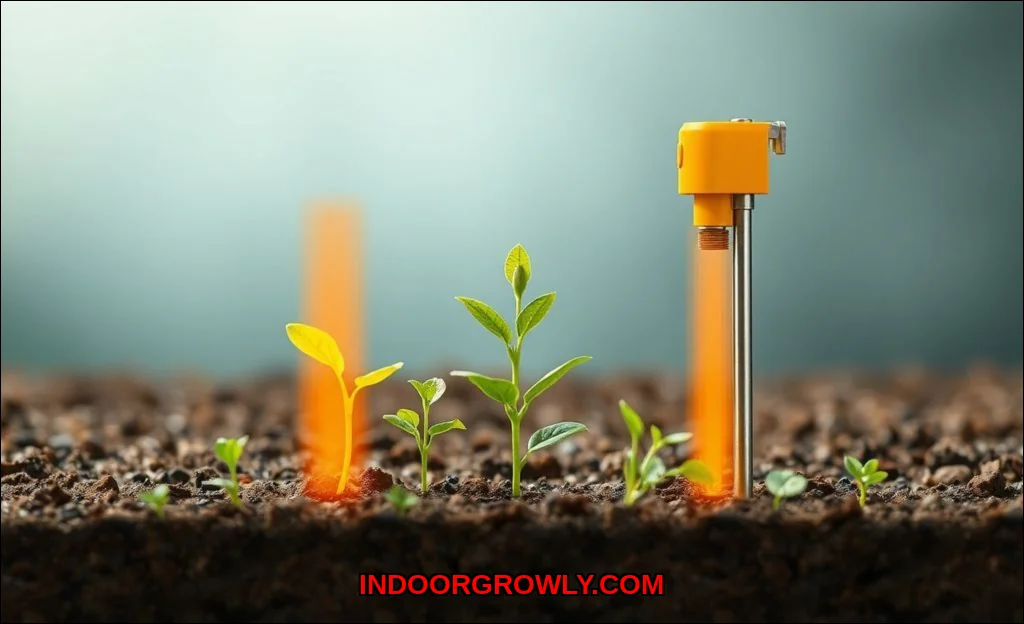
How Soil Moisture Sensors Actually Work
Not all sensors measure water the same way. The technology inside dictates its accuracy, cost, and ideal use case. Knowing the difference is your first step to a smart purchase.
Volumetric vs. Tension: Two Ways to Measure Thirst
This is the fundamental split. Volumetric water content (VWC) sensors tell you the percentage of water in your soil volume. Think of it as “how much water is in the bucket.” It’s a direct measurement, often expressed as a percentage (e.g., 25% VWC).
Soil tension measurement, on the other hand, gauges how hard the plant roots have to work to pull water from the soil. It’s measured in units called centibars (cb) or kilopascals (kPa). A higher number means drier soil and more stress for the plant. This tells you “how available the water is.”
Sensor Technology Deep Dive
Heres how the common sensor types map onto these measurement principles.
Tensiometers: The Gold Standard for Tension
These are simple, physical devices. A porous ceramic tip is buried in the soil and connected to a water-filled tube and a vacuum gauge. As soil dries, it pulls water from the tip, creating suction measured on the gauge. They are excellent for telling you when to water but require maintenance (refilling) and can break in freezing temps.
Dielectric Sensors: Modern Volumetric Measurement
Most modern sensors, from consumer gadgets to pro-grade gear, use dielectric principles. They measure the soil’s dielectric constantbasically, how well it holds an electrical charge. Since water has a much higher dielectric constant than soil or air, the sensor can infer water content. This category includes several methods:
- Capacitive vs. Resistive Sensors: Cheap analog meters (like the XLUX) are typically resistive. They pass a current between two probes; more water means less resistance. They are prone to corrosion and salinity errors. Capacitive sensors, like those from Vegetronix, use a single probe to measure charge capacity. They are generally more durable and accurate.
- Frequency Domain Reflectometry (FDR) & Time Domain Reflectometry (TDR): These are the high-accuracy standards used by brands like Decagon and Acclima. FDR is common in professional agricultural monitoring. TDR is incredibly accurate but often more expensive. Both send an electrical signal into the soil and analyze its return to calculate VWC.
Other legacy technologies like Gypsum Blocks still exist but are less common due to slower response times and the need for a calibration for soil type.
What to Compare: Accuracy, Placement, and Data
Beyond the tech specs, practical performance matters most in your garden or field.
Key Metrics: Accuracy, Range, and Response
Ask these questions before you buy:
- Accuracy: How close is the reading to the truth? A professional FDR sensor might be 1-2% VWC. A cheap meter might be 10% or just give you a “dry/moist/wet” range. This is why people ask, “how accurate are cheap soil moisture meters?”
- Range: Does it measure the full spectrum from bone dry to saturated? Some sensors lose accuracy at extremes.
- Response Time: How fast does it reflect a change after watering? Minutes are good for irrigation control; hours are not.
Don’t overlook environmental factors. The impact of soil salinity on readings is significant for dielectric sensors, as salts conduct electricity and can inflate water content readings. Sensor material also degrades. Consider sensor longevity & degradation ratescheap metal probes corrode, while quality encapsulated probes last for years.
Installation is Everything
A perfect sensor in the wrong spot is useless. For a vegetable garden, you need to measure the root zone.
- Depth: Place the sensor’s active zone within the main root mass. For tomatoes, that’s 6-12 inches down. For lawns, 3-6 inches.
- Location: Avoid the very edge of a bed or directly under an emitter. Aim for a representative spot.
- Soil Contact: This is critical. When installing wireless soil sensors in raised beds, ensure the probe is fully inserted into undisturbed soil, not an air pocket. You may need to pre-drill a pilot hole.
For container plants, a simple probe like a soil moisture meter for indoor plants is often sufficient. The key is consistent placement.
From Data to Action: Connectivity & Integration
A number on a screen is just data. An automated watering decision is a solution.
- Basic Readouts: Analog dials or simple digital displays. You take the reading and decide to water.
- Bluetooth/Wi-Fi Wireless Soil Probes: These send data to your phone. Great for monitoring while you’re away.
- Smart Irrigation Controller Integration: This is the game-changer. Sensors from companies like Rain Bird or Netafim can talk directly to their irrigation controllers, turning your system on and off based on actual soil conditions, not just a timer.
- Open-Source & DIY Hubs: The maker community has embraced smart farming at home. Open-source sensor alternatives exist, and many tech-savvy growers look for soil moisture sensors that work with Home Assistant for complete smart home integration.
| Sensor Type | Best For | Key Consideration |
|---|---|---|
| Resistive Probe (e.g., basic meter) | Hobbyists, quick checks, low budget | Prone to corrosion; requires calibration for soil type |
| Capacitive Probe | Serious gardeners, durability | Better accuracy than resistive; good for long-term burial |
| Tensiometer | Scientific growing, specific crop stress monitoring | Measures water availability directly; requires maintenance |
| FDR Wireless Sensor | Professional landscaping, agriculture, tech-integrated gardens | High accuracy; enables true automated smart irrigation |
Making the Choice: Cost vs. Value for Your Needs
Your budget and goals will point you to the right category. Let’s break down the value.
Consumer Garden Sensors ($10 – $150)
This range covers analog stick meters to single wireless probes. Value comes from convenience and basic data. The XLUX Soil Moisture meter we mentioned earlier is at the very low endit’s a tool for instant, localized checks. Moving up, a $50-80 wireless probe that logs data to your phone offers much more insight for a moderate investment. It’s perfect for figuring out the best soil moisture sensor for a vegetable garden patch.
Professional & Smart System Sensors ($150 – $500+)
Here you’re paying for research-grade accuracy, ruggedness for permanent installation, and seamless integration. The value is in water savings, optimized plant health, and labor reduction. If you have a complex irrigation system or a commercial operation, this is where the ROI becomes clear. Brands like Decagon dominate this space.
The Calibration Conversation
All dielectric sensors benefit from calibration. The manufacturer uses a default calibration curve, usually for a mineral soil. If you’re growing in a unique medialike a dense clay or a soilless potting mixyour readings may be off. You can significantly improve accuracy by taking a sensor reading, then sampling the soil to physically measure its water content (by weighing, drying, and re-weighing). This lets you create a custom offset. Resources like Planet Natural’s guide to growing indoors often touch on these finer points of environmental control.
Putting It All Together
Start with your “why.” Are you trying to save a finicky fiddle-leaf fig, boost tomato yields, or automate a greenhouse? For most home gardeners, a mid-range capacitive or simple FDR sensor with Bluetooth is the sweet spot. It provides reliable data without overwhelming complexity.
Remember, the sensor is just one part of your plant watering system. Its placement is non-negotiable. Its data needs to lead to an actionwhether that’s you turning on a hose or a smart irrigation controller doing it for you. For specialized container growing, like maintaining perfect moisture for miniature trees, the principles of sensor placement are even more critical, as discussed in our guide on using indoor bonsai soil moisture sensors.
Skip the guesswork. Invest in the right level of gardening technology for your needs, install it correctly, and let the roots tell you what they need. Your plantsand your water billwill thank you.