
You’ve invested in smart grow lights to create the perfect environment for your plants. But you’ve noticed a green, slimy film in your reservoir or on your growing media. Algae. It’s a common frustration in hydroponics and indoor gardening, and your powerful lights are often the unwitting accomplice. The good news is that with the right strategy, you can use those same smart lights as your primary defense.
Algae growth under grow lights is a symptom of an environmental imbalance, not a cause. It thrives where light, nutrients, and moisture converge. Your goal isn’t just to kill algae; it’s to make the entire root zone environment unfavorable for it while remaining optimal for your plants. This requires a multi-pronged approach, and your smart lights are a critical piece of the puzzle. For persistent issues in larger or recirculating systems like DWC, a final mechanical barrier can be invaluable. Many growers integrate a hygger Aquarium U-V sterilizer into their setup, which uses ultraviolet light to disrupt algae cells in the water column without affecting nutrients.
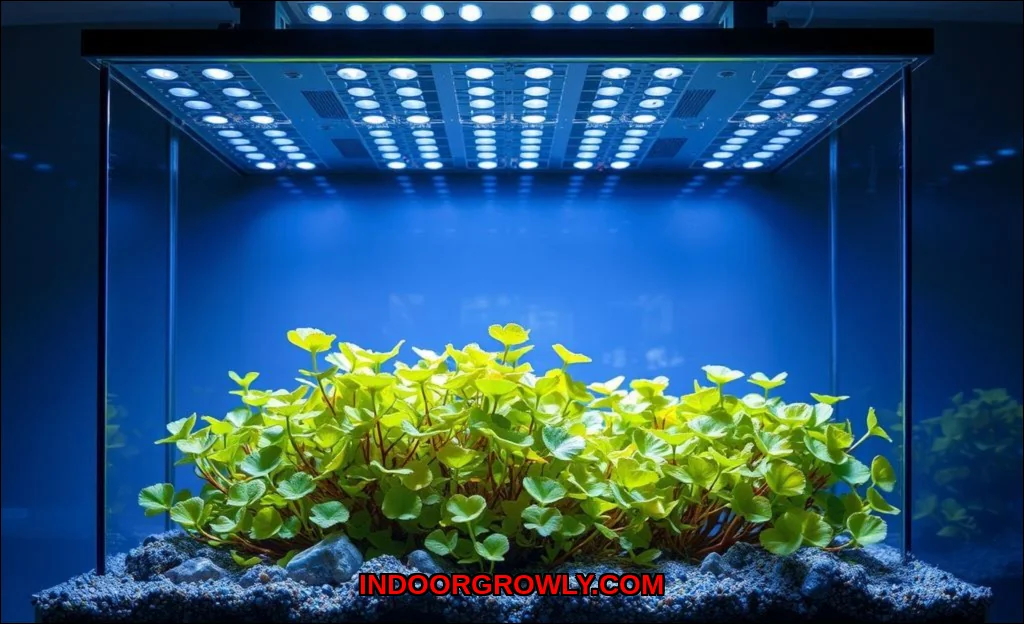
Why Algae Thrives Under Your Smart Grow Lights
Algae are simple, photosynthetic organisms. They need the same basic things your plants do: light, water, carbon dioxide, and nutrients. Your hydroponic system provides an abundant, constant supply of the latter three. The primary variable you control is light. When light reaches your nutrient solution or moist growing medium, you’ve created an algae paradise.
The key entity here is photosynthetically active radiation (PAR), the spectrum of light (400-700 nm) that plants and algae use for photosynthesis. Smart lights excel at delivering targeted PAR, but any stray light hitting wet surfaces is an invitation. Cyanobacteria (often called blue-green algae) are particularly problematic, as they can form resilient films and some types may produce toxins.
Common scenarios that trigger outbreaks include:
- Light leaks into your reservoir or onto rockwool cubes.
- Running light cycles that are too long or intense for the plant’s stage, providing excess energy.
- Using broad-spectrum white light that penetrates deeper into the water column compared to more targeted red/blue spectrums.
- High water temperatures that increase metabolic rates of both plants and algae.
Answering Your Top Question: Why Does Algae Grow Under My LED Grow Lights?
LEDs are efficient and cool, but they are intense and direct. If the light source or its reflection reaches any standing nutrient solution, algae will exploit it. This is especially true in systems like Deep Water Culture (DWC) or Nutrient Film Technique (NFT), where roots are directly bathed in lit fluid. The question isn’t really “if” but “how much,” and your management practices determine the answer.
Optimizing Your Smart Light Spectrum and Intensity
This is where smart lights transition from a potential problem to a powerful solution. Their true value lies in programmability. A static ‘vegetative’ schedule is often less effective than a dynamic one that considers overall system health.
Tuning the Spectrum to Outcompete Algae
Different light spectra affect algae differently. While plants use a broad PAR range, you can tailor spectra to favor your crops.
- Blue Light & Algae: There’s a common query: does blue light cause more algae growth? Research suggests blue light (around 450nm) can promote certain algae types. While plants need blue for vegetative growth, excessive blue can be counterproductive. Use your smart light’s app to moderate blue intensity, ensuring it’s sufficient for plant development without over-saturating the environment.
- Red & Far-Red Dominance: Algae are generally less efficient at using longer red wavelengths (660nm+) than plants. Shifting to a spectrum with stronger red dominance during key growth phases can give your plants a competitive edge, a concept explored in resources on how smart grow lights improve indoor plant health.
Mastering Light Cycle Management and Intensity
The photoperiod and intensity are just as important as spectrum. Your goal is to deliver the precise light intensity your plants need, and not a lumen more.
- Find the Minimum Effective Dose: Use light meters or your light’s built-in controls to avoid running at 100% power unnecessarily. Higher intensity doesn’t always mean better growth, and it certainly means more energy for potential algae.
- Program Strategic Dark Periods: Algae require continuous light to bloom. Ensure your dark period is truly dark for the root zone. This is a critical part of the best smart light schedule to prevent algaeone that includes ample, uninterrupted darkness for the reservoir.
- Leverage Dawn/Dusk Simulations: Some smart lights can gradually ramp intensity. This can be gentler on plants and may reduce the “shock” that can sometimes stress plants and make them more susceptible to other issues.
Mastering Environmental Controls Beyond Lighting
Smart lights are a tool for prevention, not a cure. Ignoring other environmental factors will undermine your efforts. You must manage the entire microclimate.
Critical Role of Humidity and Temperature Control
Humidity control is paramount for foliar health, but it also affects surface moisture. High humidity slows evaporation, leaving growing media damp and inviting. Use dehumidifiers or increase airflow to keep relative humidity in the optimal range for your plants.
Water temperature is arguably the most important non-light factor. Warm water (above 70F/21C) holds less dissolved oxygen and accelerates algae and pathogen growth. Use a water chiller to maintain reservoir temperatures between 65-68F (18-20C). This suppresses algae and increases oxygen levels for healthier roots.
Oxygenation and Beneficial Biology
Aerobic, healthy root zones resist algae. Increase dissolved oxygen with strong air stones and water movement. More importantly, introduce beneficial bacteria through commercial products or compost teas. These microbes outcompete algae for resources and create a robust rhizosphere. They are your biological army.
Implementing Proactive Reservoir and System Maintenance
Your maintenance routine is your weekly defense. Consistency here prevents small problems from becoming disasters.
Reservoir Hygiene: How to Clean Algae from Hydroponic Reservoir
When you see algae, act immediately. Here’s a proven cleaning protocol:
- Empty and remove the reservoir.
- Scrub with a 3% hydrogen peroxide solution or a diluted bleach mix (1 part bleach to 9 parts water).
- Rinse thoroughly to remove all cleaning residue.
- Refill with fresh, temperature-adjusted nutrient solution.
- Re-introduce beneficial bacteria.
Use opaque, light-proof materials for reservoirs and tubing. If using buckets, wrap them in reflective but light-blocking tape or paint. Regularly check for and eliminate all light leak points.
Nutrient Solution Management
Algae feast on the same nutrient solution as your plants. Avoid over-fertilization. Keep EC/PPM levels precisely where your plants need them. Change your reservoir completely every 7-14 days to prevent nutrient imbalances and algal spore buildup. This regular refresh is non-negotiable.
Troubleshooting and Correcting Active Algae Outbreaks
Despite best efforts, outbreaks happen. Your response should be swift and measured.
Immediate Action Steps
- Block the Light: Identify and cover the light source immediately. Use aluminum foil or light-proof fabric.
- Lower Temperature: Add frozen water bottles to the reservoir to drop the temperature quickly.
- Increase Aeration: Maximize oxygen levels to support plant roots and beneficial microbes.
- Apply a Algaecide (Carefully): Food-grade hydrogen peroxide (H2O2) can be used as a shock treatment. Typical dose is 2-3ml per gallon of 3% H2O2. It will kill algae on contact and add oxygen, but it can also harm beneficial bacteria. Use as a last resort.
System-Specific Strategies
For NFT systems, ensure channels have adequate slope and no pooling. In DWC, focus on total light exclusion from the reservoir lid. For media beds, improve top-layer drainage and consider a dry-out period. Testing different environmental setpoints is key, which is why fine-tuned growth testing with smart lights is such a valuable long-term strategy.
Your Blueprint for an Algae-Free Garden
Preventing algae under smart grow lights is a holistic practice. It starts with recognizing that algae is an indicator, not the core problem. Your smart lights give you unprecedented control over the first part of the equationlight spectrum, intensity, and photoperiod. Use that control precisely. Pair it with rigorous environmental management: cool nutrient solutions, high dissolved oxygen, and vigilant humidity control. Enforce a strict maintenance schedule with light-proofing as your mantra.
Embrace the role of beneficial biology. When every other factor is dialed in, your plants and their microbial allies will naturally resist invaders. Your smart system isn’t just about automating light; it’s about creating a stable, optimized environment where your chosen plants thrive, and competitors like algae simply can’t. Stay observant, act proactively, and enjoy the clean, vigorous growth that follows.