
Getting your LED grow lights dialed in is one thing. Managing the humidity they influence is another. The two are deeply connected in your grow space. Unlike traditional HPS lights that blast radiant heat, modern LEDs affect your environment more subtly. They drive plant processes that directly change the humidity around your canopy. If you’ve ever seen condensation on your tent walls or noticed slow, leggy growth, you’ve witnessed this relationship firsthand.
Your goal isn’t just to hit a random humidity percentage. It’s to create a balanced environment where light, temperature, and humidity work together for optimal plant health. This balance governs critical functions like Transpiration and nutrient uptake. For precise, automated control over this variable, many growers integrate a tool like the Inkbird Humidity Controller. It takes the guesswork out of maintaining your target range by turning humidifiers or dehumidifiers on and off as needed.
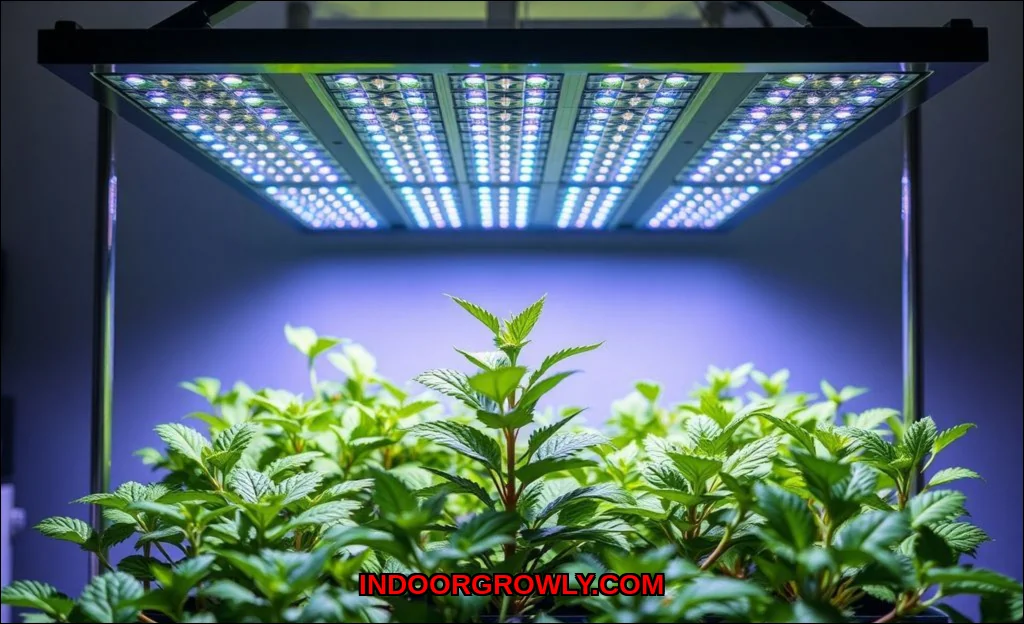
The Core Relationship: Light, Heat, and Plant Humidity
LEDs produce light with high efficiency, meaning less energy is wasted as broad-spectrum heat. However, they still generate warmth, and more importantly, their light intensity drives photosynthesis. As your plants photosynthesize under the Photosynthetically Active Radiation (PAR) from your LEDs, they open their stomata to take in CO2. This process releases water vapora key factor in your tent’s humidity level.
Think of it this way: your LED light is the engine for Transpiration. A higher PPFD (Photosynthetic Photon Flux Density) typically means a higher transpiration rate, raising humidity. But if the air is already saturated, stomata close, growth stalls, and the risk of mold skyrockets. This is why understanding the light intensity transpiration link is your first step toward true environmental control.
Why Leaf Temperature is a Game-Changer
Heres a critical insight often missed: under LEDs, leaf surface temperature (LST) is usually lower than the ambient air temperature. This happens because LEDs emit very little Infrared (IR) Radiation, which warms leaf tissue directly. A cooler leaf affects the relative humidity right at the leaf boundary layerthe canopy microclimate. If your LST is too low, moisture can condense on the leaves, inviting pathogens. Monitoring LST with an infrared thermometer is essential for diagnosing humidity issues.
The Essential Guide to Vapor Pressure Deficit (VPD)
Forget chasing static humidity numbers. Vapor Pressure Deficit (VPD) is the metric that matters. It describes the difference between the amount of moisture in the air and the amount it can hold when saturated. In practical terms, VPD tells you the “drying power” of your grow space air. Its the driving force behind transpiration.
A proper VPD range encourages plants to drink and transpire at an ideal rate, pulling nutrients from the roots. If VPD is too low (high humidity, low temperature), transpiration slows, risking nutrient deficiencies and mold. If VPD is too high (low humidity, high temperature), plants close stomata to conserve water, stressing them and halting growth.
How to Use a VPD Chart
Youll use a VPD chart by cross-referencing your room’s temperature and relative humidity. The sweet spot is typically between 0.8 and 1.2 kPa for most plants in vegetative growth, shifting higher during flowering. Because LEDs cool leaf surfaces, you often need to adjust your ambient temperature upward to hit the ideal VPD. This directly influences your grow tent humidity control strategy.
| Growth Stage | Target VPD Range (kPa) | Typical RH % (at ~77F/25C Leaf Temp) |
|---|---|---|
| Seedling / Clone | 0.4 – 0.8 | 65-75% |
| Vegetative | 0.8 – 1.2 | 55-65% |
| Flowering / Fruiting | 1.2 – 1.6 | 45-55% |
Step-by-Step: Adjusting Lights for Optimal Humidity
Your lights are your primary tool for steering plant activity. Heres how to adjust them with humidity in mind.
1. Assess and Measure Your Baseline
First, measure your current environment at canopy level: PPFD (with a meter), temperature, humidity, and ideally, leaf surface temperature. Note your light’s height and intensity setting. This is your starting point.
2. Solve High Humidity Problems
If humidity is consistently too high, lowering your light intensity (PPFD) can reduce the transpiration drive. This is often more effective than just raising the light. Ask yourself: does reducing LED light intensity lower humidity? Often, yes. Increasing air circulation LED heat distribution with more fans also prevents stagnant, moist pockets. For severe cases, you must integrate a dehumidifier. The external exhaust fan is your best friend here, directly removing warm, humid air from the tent.
3. Solve Low Humidity Problems
Low humidity usually means VPD is too high. You can try increasing light intensity slightly to raise leaf temperature (if using lights with some IR) or lowering the lights to increase PPFD and transpiration. However, be cautious not to cause light stress. Adding a humidifier to the space, controlled by a sensor, is the most direct and stable solution.
4. Adjust for Plant Stages
Your strategy changes as plants grow. For the best humidity for seedlings under LED grow lights, keep PPFD lower (200-400 mol/m/s) and humidity higher to minimize water stress on underdeveloped roots. During flowering, higher light intensity is needed, but humidity must come down. This is where the PPFD VPD relationship becomes criticalyou may need to increase temperature to maintain a safe VPD as you lower humidity.
Integrating Lights with Full Environmental Controls
Professional Controlled Environment Agriculture (CEA) doesn’t treat lights, climate, and irrigation as separate systems. They are integrated. You can adopt this approach at any scale.
- Environmental Controllers: These units can connect your exhaust fans, humidifiers, dehumidifiers, and even smart adjustable spectrum LED grow lights. They make coordinated adjustments based on a single sensor, maintaining your VPD setpoint automatically.
- Light Schedules & Photoperiod: Your Photoperiod dictates the daily humidity cycle. Lights-off periods often see temperature drops and humidity spikes (as transpiration stops but water remains in the medium). Program your dehumidifier to work harder during dark hours or ensure your exhaust fan remains active.
- Airflow is Non-Negotiable: Proper air circulation breaks up the humid boundary layer around leaves, equalizes temperature, and strengthens plants. It prevents microclimates where mold can start, making your other humidity control efforts far more effective.
Troubleshooting Common Humidity & Light Problems
Problem: Humidity spikes right after lights turn off.
Solution: This is normal due to the temperature drop. Ensure your exhaust fan continues running. Gradually lowering light intensity for the last 30 minutes of the photoperiod can create a softer transition.
Problem: Leaves are wet with condensation in the morning.
Solution: Your leaf surface temperature is falling below the dew point. Increase nighttime temperatures slightly, improve air movement directly across the canopy, or reduce watering frequency before lights out.
Problem: Struggling with how far should LED lights be from plants in high humidity.
Solution: Distance is a tool for managing light intensity (PPFD), not humidity directly. In high humidity, you might raise lights slightly to lower PPFD and slow transpiration, but this is a fine-tuning move. Your primary actions should be increasing exhaust and potentially using a dehumidifier. For more on optimizing light placement for growth, see our guide on why plant growth needs adjustable LED grow lights.
Problem: Plants seem thirsty but humidity is high.
Solution: This is a classic sign of low VPD. The air is so saturated that plants can’t transpire effectively, so they don’t pull water/nutrients. Increase temperature (to raise VPD) and verify your air circulation is adequate. Check your readings against a VPD chart.
Bringing It All Together
Adjusting LED grow lights for humidity is an exercise in balance. You’re managing the energy input (light) that fuels the biological process (transpiration) that affects the environmental variable (humidity). Start by measuring everythingespecially VPD. Use light intensity as a dial to influence plant water use, and support that with robust air circulation and dedicated humidification or dehumidification as needed.
Remember, the most sophisticated indoor horticulture and hydroponics setups treat climate as a single, interconnected system. By understanding the indirect effects of your Full-Spectrum LED Grow Lights, you move from reacting to problems to proactively designing an ideal environment. For further research on lighting fundamentals, academic resources like this scientific overview of grow lights and practical guides from university extension services offer valuable depth. Now, go check your leaf temperature. Your plants will thank you for it.