
Getting your plants to flower indoors is a delicate art. You’re essentially playing the role of the sun, and the timing, color, and intensity of your light are your most powerful tools. Traditional grow lights get you part of the way, but smart grow lights give you the precision to truly optimize the flowering stage for bigger yields and higher quality. They move beyond simple illumination to become an active environmental controller.
Think of it this way: flowering isn’t just about more light; it’s about the right light signals. Plants use specialized photoreceptors like Phytochrome, Cryptochrome, and Phototropin to sense their environment. By manipulating light spectrum and Photoperiod with smart technology, you can speak directly to these plant senses. For gardeners seeking a user-friendly entry into this level of control, a product like the Necgemlex Smart LED offers app-based scheduling and spectrum tuning, making advanced techniques accessible.
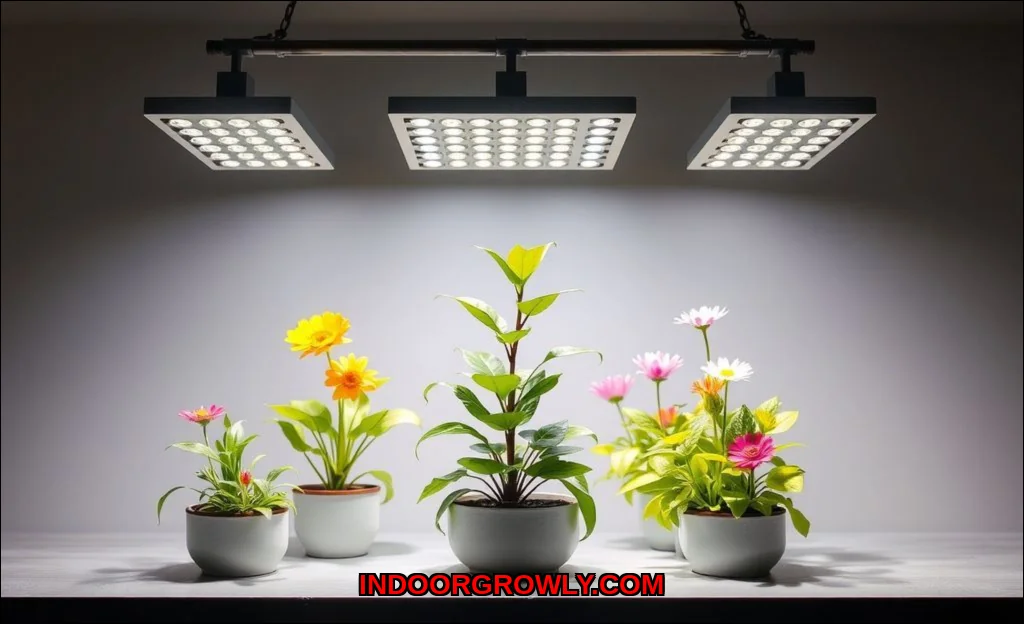
The Foundation: Plant Photoperiodism and Flowering
At its core, flowering is governed by photoperiodisma plant’s response to the relative lengths of day and night. This is how plants know what season it is. You classify plants as short-day (flower when nights are long), long-day (flower when days are long), or day-neutral. With smart LED grow lights, you’re no longer limited by the calendar. You dictate the seasons.
You set a precise light schedule automation to trigger and sustain the bloom phase. For a short-day plant like cannabis or poinsettia, you might switch from an 18/6 schedule (18 hours light, 6 dark) in vegetation to a strict 12/12 schedule to induce flowering. The consistency is key; even a small light leak during the dark period can disrupt hormone production and cause stress. Smart systems eliminate human error with automated, reliable timers.
This precise control is a cornerstone of modern year-round indoor cultivation, allowing for continuous harvests independent of outdoor conditions.
Speaking in Color: Optimizing the Light Spectrum
Once you’ve set the schedule, the color of your light becomes the primary dial for quality. Not all PAR light is equal. Different wavelengths trigger different morphological responses, a process known as photomorphogenesis.
- The Red Light Spectrum (660nm): This is the powerhouse for flowering. It’s efficiently absorbed by chlorophyll and is the primary driver of the flowering stage. High levels of red light promote stretching, flowering initiation, and bud development. The red light spectrum is your main tool for increasing biomass during bloom.
- The Blue Light Ratio (450nm): Blue light keeps plants compact and bushy. During flowering, you need less blue than in vegetation, but a small amount remains crucial. It strengthens stems to support heavy buds and influences secondary metabolite production (think terpenes and flavonoids). Getting the blue light ratio right prevents lanky, weak growth.
- Far-Red Light (730nm): This is an advanced tool. Far-red is barely used for photosynthesis but is critically sensed by phytochrome. When used at the end of a light period, it can trigger a ‘shade avoidance’ response, tricking the plant into thinking the day is over faster. This accelerates the transition to floweringa technique known as the ‘end-of-day far-red pulse.’ It can shave days off your vegetative-to-flower switch.
Smart lights enable dynamic “light recipes.” You can start the flowering cycle with a spectrum higher in far-red to speed up the transition, then shift to a deep red-heavy spectrum for bulk development, and finally incorporate more blue in late flower to boost resin and terpene production. This is how you craft a smart light spectrum for increased flower yield and quality.
Precision Delivery: Intensity, Duration, and PPFD
Color is meaningless without the right intensity. This is where PPFD (Photosynthetic Photon Flux Density) comes in. PPFD measures how many photosynthetically active photons hit a given area every second. It’s the metric that matters for growth.
Flowering plants are hungry for light. Generally, they can handle and require higher PPFD levels than seedlings or vegetative plants. However, there’s a sweet spot. Too little, and your yield suffers. Too much, and you cause light stress, bleaching, or nutrient burn. A common best light schedule for flowering plants involves not just changing the on/off times but also ramping up PPFD intensity gradually as buds develop.
Smart lights with DLC dimming (Digital Linear Current) allow you to dial in the exact intensity from 0% to 100% without changing the light spectrum. This is invaluable. You can:
- Seedlings gently without burning them.
- Gradually increase intensity as plants acclimate.
- Reduce intensity during the final weeks to potentially stress plants into producing more protective compounds (like anthocyanins).
Managing this alongside other factors like temperature and humidity is key to maintaining overall plant health under artificial light.
| Growth Stage | Recommended PPFD Range (mol/m/s) | Spectrum Focus |
|---|---|---|
| Seedling / Clone | 200 – 400 | Higher Blue, Gentle Intensity |
| Vegetative | 400 – 600 | Balanced Blue & Red |
| Early Flowering | 600 – 900 | Increasing Red, Lower Far-Red |
| Mid-Late Flowering | 900 – 1100+ | Heavy Red, Maintained Blue |
The Smart Advantage: Automation and Environmental Integration
This is where smart technology transforms complexity into simplicity. Manually how to adjust grow lights for bloom phase every day is tedious and imprecise. Smart systems let you create and deploy entire growth profiles.
You program a schedule that automatically changes the spectrum and intensity over weeks. At 6 AM, the lights ramp on to a specific spectrum and 40% intensity. By noon, they peak at 80% with a slightly adjusted color ratio. At 6 PM, they deliver a 10-minute far-red pulse before shutting off. This is automating grow lights for flowering cycle perfection.
the best systems integrate with other sensors. If your temperature sensor reads too high, the lights can automatically dim slightly to reduce heat stress. If humidity spikes, the system can adjust the environment holistically. Brands like Philips GreenPower, Gavita, and Fluence Bioengineering are at the forefront of this integrated, data-driven approach for Controlled Environment Agriculture (CEA).
Putting It All Together: A Practical Flowering Protocol
- Week 1 (Transition): Switch to a 12/12 light schedule. Use a spectrum with a slightly elevated far-red component for the first few days to accelerate the hormonal shift. Start PPFD at around 600 mol/m/s.
- Weeks 2-4 (Stretch & Bud Set): The plant will stretch. Shift spectrum to a strong red-dominant mix. Gradually increase PPFD to 800-900 mol/m/s. Ensure good airflow as foliage expands.
- Weeks 5-7 (Bulking): This is peak light demand. Run your highest PPFD levels (900-1100) with a deep red spectrum. Monitor plant health closely for any signs of light stress.
- Weeks 8+ (Ripening): Some growers slightly reduce PPFD (to ~800) and increase the blue ratio slightly. This can encourage tighter bud structure and enhance final oil/resin quality. Begin flushing if required.
The goal is to give your plants a perfect, stress-free seasonal journey. You’re not just providing energy; you’re providing information. By leveraging smart grow lights to control photoperiod, spectrum, and intensity with precision, you move from hoping your plants flower to commanding them to thrive. It turns indoor gardening from a hobby into a true science, where every photon is purposefully placed. Start with one adjustmentmaybe perfecting your light scheduleand build your control from there. The results will speak for themselves.