
Think of your plants as sophisticated biochemical factories. Every process, from leaf expansion to fruit production, is driven by metabolism. For decades, growers focused on light intensity alone. Now, smart grow lights let you directly influence the metabolic rate and pathways within your plants. It’s a shift from simply providing energy to sending precise instructions.
You’re no longer just a gardener; you’re a metabolic engineer. By manipulating light spectrum, intensity, and timing with smart technology, you can accelerate growth, enhance nutrient uptake, and even steer plants toward specific traits. For instance, a system like the Necgemlex Smart LED gives you this level of programmable control from your phone, making advanced techniques accessible.
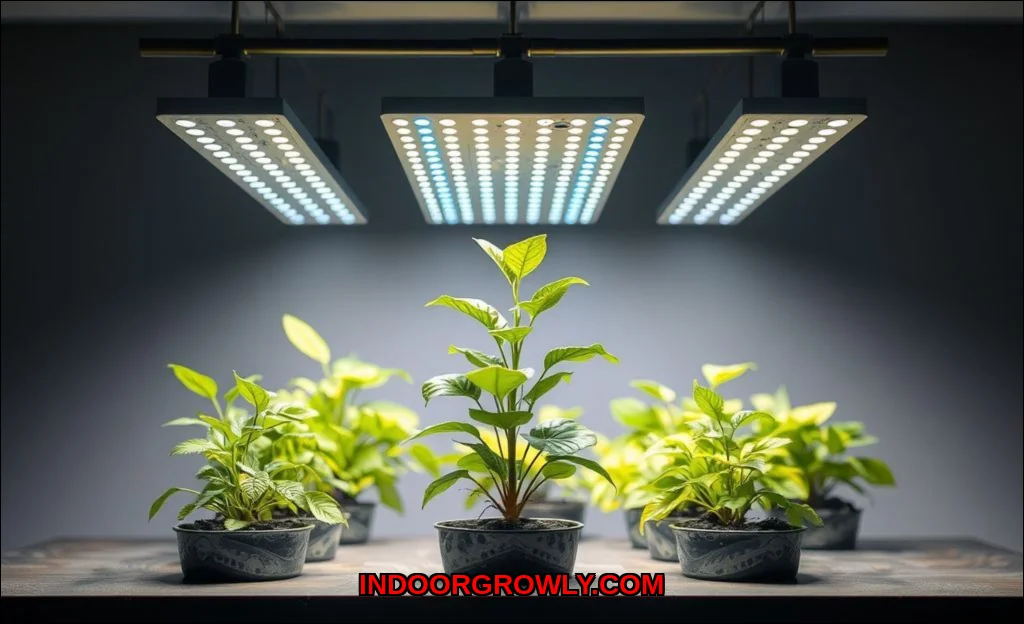
How Light Drives the Plant Engine: Photosynthesis 101
At its core, plant metabolism is fueled by photosynthesis. This isn’t just about “light.” It’s about photons that chlorophyll molecules can absorb, primarily in the blue and red wavelengths. The rate of this energy capture is measured as Photosynthetic Photon Flux Density (PPFD)the number of photosynthetically active photons hitting a square meter each second.
But PPFD is a snapshot. The total daily dose of light energy is what truly drives growth, quantified as the Daily Light Integral (DLI). Think of PPFD as intensity and DLI as the total calories consumed in a day. A smart light system allows you to automate both, ramping up intensity to meet a target DLI and then dialing it back, preventing light stress while maximizing photosynthetic output.
- Blue Light (400-500nm): Powers the high-energy reactions of photosynthesis and strongly influences stomatal opening. This directly links to blue light stomata opening, increasing gas exchange and, consequently, metabolic activity.
- Red Light (600-700nm): The most efficient driver of the Calvin Cycle, where CO2 is fixed into sugars. It’s the primary fuel for biomass accumulation.
Getting the light quality plant metabolism equation right means balancing these spectra. A high LED spectrum photosynthesis rate depends on providing the right photons at the right intensity for your specific crop’s needs.
Beyond Energy: Light as an Information Signal (Photomorphogenesis)
Here’s where it gets fascinating. Plants don’t just use light for food. They use specific wavelengths as environmental cues through specialized photoreceptors. This process, called Photomorphogenesis, dictates plant shape, size, and internal chemistry. Smart lights let you “speak” directly to these receptors.
The Key Photoreceptors and Their Metabolic Roles
- Phytochrome: Senses red (660nm) and far-red (730nm) light. The ratio between these (the R:FR ratio) is a primary signal. A high ratio (more red) tells the plant it’s in full sun, promoting compact, leafy growth. A low ratio triggers ‘shade avoidance’accelerating stem elongation and shifting metabolism away from roots and leaves. You control this.
- Cryptochrome & Phototropin: These are primarily blue light receptors. They regulate stomatal conductance, phototropism (bending toward light), and the production of secondary metabolites like antioxidants.
By adjusting the phytochrome Pr to Pfr ratio with tunable spectra, you can essentially tell your plant whether to bush out or stretch, to prioritize leaf growth or prepare to flower. This is a direct metabolic command.
The Smart Light Advantage: Precision Control of Metabolic Levers
Traditional lights are a blunt instrument. Smart, full-spectrum LED systems are a scalpel. They enable the creation of dynamic “light recipes”prescribed spectral blends delivered at precise times to elicit desired plant responses. This is the heart of modern Controlled Environment Agriculture (CEA).
Expert insight confirms this: The concept of ‘light recipes’ is central to smart lighting. It’s not just about intensity; it’s about delivering specific spectral blends at precise times to steer plant morphology and secondary metabolite production. Want more basil with higher essential oil content? There’s a light recipe for that. Need lettuce with boosted antioxidant levels? That’s programmable.
This control answers questions like can grow lights change plant nutrient uptake? Absolutely. By influencing root-shoot allocation via phytohormone signals (like auxin and gibberellin) triggered by light quality, you affect how and where nutrients are used. Enhanced stomatal conductance from blue light also improves the uptake of foliar-applied nutrients. For a deeper dive into how these systems monitor and adapt, explore our guide on how smart grow lights improve plant response measurement.
Practical Guide: Optimizing Smart Lights for Desired Metabolic Outcomes
So, how do you apply this? Let’s translate the science into actionable steps. Your goal is to match your light recipe to your plant’s phase and your desired outcome.
1. Boosting Vegetative Growth & Leaf Metabolism
You want rapid, compact growth with high photosynthetic capacity.
- Spectrum: Higher ratio of blue light (20-30%) to red. This promotes tight internodal spacing, thick leaves, and robust stomatal development.
- Intensity/DLI: Target a high but species-appropriate DLI. For many leafy greens, 12-17 mol/m/day is effective.
- Ask: Does blue light increase plant metabolism? In the vegetative stage, yesit optimizes the photosynthetic machinery and gas exchange capacity.
2. Accelerating Flowering & Fruit Metabolism
You want to trigger and support reproductive processes.
- Spectrum: Increase red and far-red. A lower R:FR ratio can hasten flowering initiation. Adding far-red at the end of the light period can mimic long days for some plants.
- Intensity/DLI: Maintain high PPFD to fuel fruit and flower development, which are energy-intensive.
- Tool: Use smart controllers to gradually shift the spectrum over days, simulating seasonal change.
3. Enhancing Secondary Metabolites (Nutrients, Oils, Scents)
You’re targeting quality over sheer biomass.
- Spectrum: Strategic use of UV-A and high blue light can stress plants in a controlled way, boosting production of defensive compounds like anthocyanins, terpenes, and antioxidants.
- Timing: Often applied in the final 1-2 weeks before harvest.
- This is the answer to finding the best light spectrum for high metabolic rate of specific compounds, not just growth.
For foundational knowledge on setting up your environment, our article on how smart grow lights improve indoor plant health is a great resource.
Expert Insights & Future Directions
The frontier of horticultural lighting is integrating smart lights with other environmental sensors. Imagine a system that increases blue light intensity when humidity sensors indicate high vapor pressure deficit, proactively tightening stomata to reduce water stress. That’s the direction.
Another key insight: Smart lights allow you to manipulate the red to far-red (R:FR) ratio, which plants use to sense competition. A low R:FR ratio triggers the ‘shade avoidance syndrome,’ accelerating stem elongation and altering resource allocationa direct metabolic shift you can control. This isn’t just for avoiding shade; it’s a tool for managing plant architecture on demand.
As you explore implementing these strategies, reviewing practical guides on LED grow light wattage and setup can help ground the science in practical hardware choices. research published in journals like Scientific Reports continues to refine our understanding of light spectra and plant physiology.
Your Path to Metabolic Mastery
Start by viewing your smart grow light as a dial for plant physiology. Begin with proven light recipes for your crop, then experiment. Monitor your plants’ responsesstem thickness, leaf color, stretching. The question how to use smart grow lights to speed up growth is nuanced; speeding up flowering requires a different recipe than speeding up leaf production.
You have the tools to move beyond passive illumination to active metabolic influence. It begins with understanding the language of light that your plants speak. Then, you program your lights to have that conversation. The result is not just faster growth, but smarter growthplants guided precisely toward your goals.