
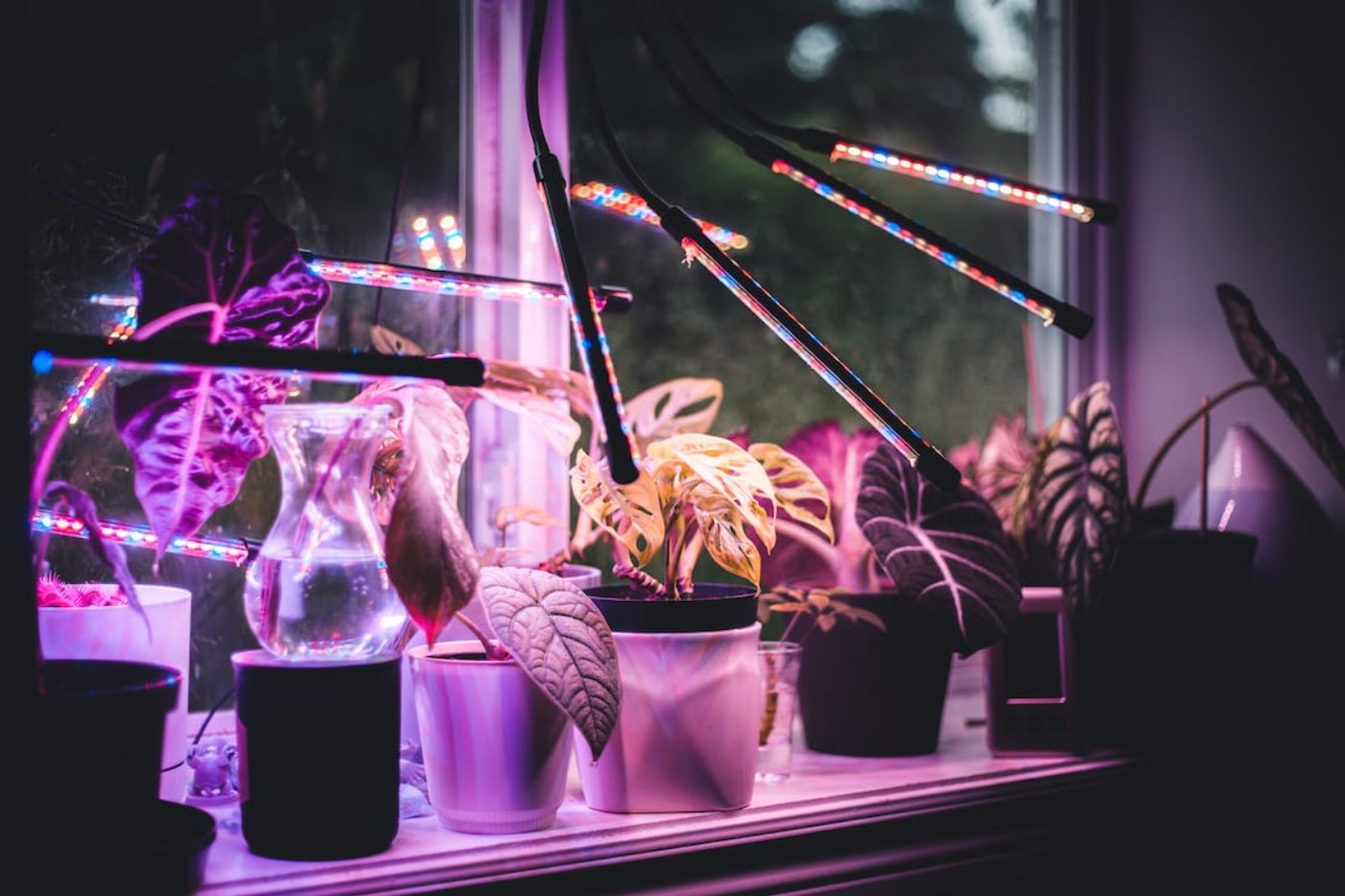
Plant growth needs adjustable LED grow lights because plants respond to specific light wavelengths within the Photosynthetically Active Radiation (PAR) range, and those needs change depending on species, growth stage, and environment. Adjustable LED grow lights allow growers to control spectrum and intensity so light aligns precisely with plant biology—optimizing photosynthesis, guiding plant structure through photomorphogenesis, improving efficiency, and reducing wasted energy compared to fixed-spectrum lighting.
Introduction to Plant Growth & Light Biology
Light is not just an energy source for plants- it is a biological signal. Through millions of years of evolution, plants have learned to read light quality, intensity, and duration to decide how to grow, when to flower, and how to defend themselves.
In natural outdoor conditions, sunlight provides a broad, dynamic spectrum that changes throughout the day and across seasons. In indoor cultivation, however, sunlight must be replaced by artificial lighting. This is where understanding plant growth biology becomes essential.
Plants use light primarily within the Photosynthetically Active Radiation (PAR) range, which spans wavelengths from approximately 400 to 700 nanometers. Within this range, different colors of light trigger different physiological responses. Artificial lighting that fails to deliver the right spectrum—or delivers it inefficiently—can limit growth, reduce yields, and waste energy.
Adjustable LED grow lights were developed specifically to solve this problem by allowing growers to match light output to plant needs.
What Is an Adjustable LED Grow Light?
An LED grow light is a horticultural lighting system that uses light-emitting diodes to produce photons tailored for plant growth. Unlike traditional lighting technologies, LEDs can be engineered to emit very specific wavelengths with high efficiency.
An adjustable LED grow light goes a step further by allowing growers to:
- Modify light spectrum (color composition)
- Adjust light intensity (PPFD levels)
- Adapt lighting schedules to growth stages
Key Characteristics of LED Grow Lights
- High energy efficiency: LEDs convert electricity into usable photons more efficiently than most legacy systems.
- Targeted photon delivery: Light output can be focused on PAR wavelengths.
- Lower heat output: Less radiant heat reaches the canopy.
- Long operational lifespan: Often exceeding 50,000 hours.
LED vs. Traditional HID/HPS Lighting
Traditional HID (High-Intensity Discharge) or HPS (High-Pressure Sodium) lamps emit a fixed spectrum and generate significant heat. While powerful, they:
- Waste energy outside the PAR range
- Require additional cooling infrastructure
- Offer little control over spectrum
Adjustable LED grow lights replace brute-force intensity with precision and control, making them better aligned with modern indoor cultivation goals.
Why Adjustability Matters for Plant Growth
Plants do not have a single, static light requirement. Their needs change constantly.
Different Growth Stages, Different Needs
- Vegetative stage: Plants benefit from higher blue light levels to promote compact growth, strong roots, and leaf development.
- Flowering or fruiting stage: Increased red light supports flower initiation, fruit development, and biomass accumulation.
An adjustable spectrum allows growers to guide plant development intentionally, rather than forcing plants to adapt to a fixed light source.
Different Crops, Different Spectral Preferences
Not all plants respond to light the same way. For example:
- Cannabis responds strongly to spectrum tuning for internodal spacing, terpene production, and flowering behavior.
- Tomatoes and cucumbers require balanced red and blue light for yield and structure.
- Leafy greens thrive under blue-heavy spectra that enhance leaf density and color.
Adjustable LED grow lights give growers the flexibility to support a wide range of crops under one system.
Advantages and Disadvantages of LED Grow Lights
Like any technology, LED grow lights come with strengths and limitations.
Advantages of Using LED Grow Lights
- High efficiency: More photons per watt compared to HID lighting
- Full spectrum lighting: Can closely replicate sunlight
- Customizable spectrum: Spectrum can be tuned to crop and stage
- Low heat output: Reduced risk of heat stress
- Closer canopy placement: Less light loss
- Long service life: Often 3–5 times longer than HID lamps
- Reduced energy consumption: Lower electricity costs over time
- Scalable designs: Suitable for small tents to large greenhouses
- Lower carbon footprint: Improved sustainability
- No toxic materials: Many LEDs are RoHS compliant and recyclable
Disadvantages of LED Grow Lights
- Higher upfront cost: Initial investment can be significant
- Blue light exposure risk: Requires eye and skin protection
- Thermal management sensitivity: Poor heat sinks reduce lifespan
- Diode aging: Low-quality chips may shift spectrum over time
Understanding these trade-offs helps growers make informed decisions.
Are LED Grow Lights Always the Best Choice?
Not always—but often.
When LEDs Make the Most Sense
- Long-term indoor cultivation
- Energy efficiency is a priority
- Spectrum control matters
- Limited cooling infrastructure
- Diverse crop types or growth stages
When HID Lighting May Still Be Used
- Short-term projects
- Lower upfront budgets
- Situations where heat is not a concern
- Large-scale operations with existing HVAC systems
However, HID systems often require additional investment in cooling, ducting, and electricity—costs that accumulate quickly. Over time, adjustable LED grow lights tend to offer a stronger return on investment.
What Is Full Spectrum Lighting?
Full spectrum lighting refers to light that contains a broad range of wavelengths across the electromagnetic spectrum, similar to natural sunlight.
This includes:
- Visible light (blue, green, red)
- Near ultraviolet (UV)
- Far-red and near-infrared
Unlike conventional indoor lighting, full spectrum LED grow lights deliver the wavelengths plants rely on for both photosynthesis and developmental signaling.
Because LEDs can be engineered at the diode level, they are uniquely capable of reproducing this balanced spectrum with precision.
How to Understand Light Spectra & Plant Absorption
Plants absorb light using specialized pigments, primarily:
- Chlorophyll a
- Chlorophyll b
- Carotenoids
These pigments absorb light at different wavelengths and convert photon energy into chemical energy through photosynthesis.
Absorption Spectrum vs. PAR Action Spectrum
- Absorption spectrum: Shows which wavelengths pigments absorb
- PAR action spectrum: Shows how efficiently those wavelengths drive photosynthesis
While red and blue light are the most efficient, plants still use other wavelengths for secondary processes. Adjustable LED grow lights allow growers to account for both efficiency and biological nuance.
Is Green Light Useful for Plants?
For many years, green light was considered unimportant because plants reflect much of it—hence their green appearance. However, recent research has challenged this assumption.
Why Green Light Matters
- Penetrates deeper into dense canopies
- Reaches lower leaves that blue and red light miss
- Contributes to photosynthesis at moderate to high intensities
- Supports chlorophyll regulation and plant balance
While green light is less efficient on a per-photon basis, it plays a meaningful supporting role—especially in mature or thick canopies.
How Light Spectrum Affects Plant Growth (Photomorphogenesis)
Photomorphogenesis refers to how light quality influences plant form and development beyond photosynthesis.
Different wavelengths trigger different responses:
- UV (280–400 nm)
Enhances plant defense mechanisms and stress resistance - Blue (400–500 nm)
Promotes compact growth, leaf thickness, and root development - Green (500–600 nm)
Supports canopy penetration and secondary photosynthesis - Red (600–700 nm)
Drives flowering, fruiting, and biomass accumulation - Far-Red (700–800 nm)
Influences stem elongation and shade-avoidance responses
Crops such as cannabis, tomatoes, and cucumbers show clear, measurable responses to spectrum manipulation—making adjustable LED grow lights particularly valuable.
Importance of Grow Light Specifications
Whether you are buying your first LED grow light or optimizing an existing setup, understanding specifications matters.
Key metrics to review:
- PPFD (Photosynthetic Photon Flux Density): Measures usable light reaching the canopy
- Spectrum charts: Show wavelength distribution
- Efficacy (µmol/J): Indicates energy efficiency
- Coverage area: Ensures uniform light distribution
Reputable manufacturers provide detailed spec sheets to help growers match lighting to their cultivation goals.
FAQ: Adjustable LED Grow Lights & Plant Growth
Are LED grow lights more efficient than HID lights?
Yes. LEDs produce more usable photons per watt and waste less energy as heat.
Are LED grow lights more expensive?
Initial costs may be higher, but long-term operating costs are typically lower.
Do LED grow lights really improve plant growth biology?
Yes. By aligning spectrum and intensity with plant biology, LEDs support faster, healthier growth.
What light colors are most important for plant growth?
Red and blue are most efficient, but green, far-red, and UV also play important roles.
Closing Thoughts: Growing with Knowledge and Precision
Understanding why plant growth needs adjustable LED grow lights is ultimately about respecting plant biology. Light is both fuel and information, and plants respond best when that information is clear, balanced, and adaptable.
Adjustable LED grow lights give indoor cultivators the tools to experiment, learn, and grow with intention-bridging science and practice. By matching light to plant needs, growers not only improve yields and efficiency but also deepen their understanding of the living systems they care for.
In indoor cultivation, better light leads to better learning—and better plants follow naturally.